Amharic Text to Speech
47 Ethiopian neural voices with Fidel script support — free MP3 download.
47 Amharic Neural Voices — Fidel Script, Ge'ez Heritage & Ethiopian Diaspora
Fidel looks beautiful on the page but intimidating to read aloud. Paste any አማርኛ text and a native Ethiopian speaker reads it back in seconds — ejective consonants, geminated stops, and all seven vowel orders intact. The library covers 47 voices trained on Amharic phonology: pick Ameha for a warm male narrator or Mekdes for a clear female presenter, then download the result as a free audio file.
Four real audiences land here every day: diaspora creators in Washington DC and Minneapolis producing Amharic voiceover for YouTube, heritage children learning to pronounce their parents' language through listening, NGO teams preparing health announcements for rural Ethiopia, and developers wiring the speech engine into Telegram bots and mobile apps. Whether the source text is a church bulletin in Ge'ez script or a short product review, the engine handles Fidel natively and outputs natural Ethiopian speech.
- 47 Ethiopian voices — all Neural PRO tier
- Male & female speakers (Ameha, Mekdes, Adam ET, Ada ET)
- Full Fidel (Ge'ez abugida) input support
- Adjustable speed & pitch
- Free — 1,000 chars, no signup
Amharic Voices — Male & Female Neural Speakers
Click to preview · 47 Ethiopian voices total
These are 4 featured speakers. Browse all 47 on the voices page — filter by am-ET.
Amharic Pronunciation — Fidel Alphabet & Key Sounds
Amharic uses Fidel, an abugida where every consonant carries a built-in vowel. Click play to hear each feature spoken by a native voice.
What Makes Amharic Pronunciation Distinctive
- Ejective consonants — Amharic has five ejective stops (ቀ ጠ ጨ ጰ ፀ) that are released with a sharp glottal burst. No European language uses them, so they trip up most foreign speakers and separate good synthesis from robotic output.
- Gemination everywhere — doubling a consonant flips meaning entirely (አለ "he said" vs አሌ "I won't"). The distinction is rarely marked in Fidel, making accurate voice modeling essential.
- Seven vowel orders per consonant — Ge'ez script is an abugida: ሀ (ha), ሁ (hu), ሂ (hi), ሃ (ha4), ሄ (he), ህ (hɨ), ሆ (ho). Each shape shift is small, so precise phoneme mapping matters for the audio output.
Amharic Text — Formatting & Input Tips
Small details in the source text change how the output sounds. Four conventions worth knowing before you paste:
Numbers
1,234 → reads as "and arba meto selasa arat" in standard Ethiopian counting. Arabic numerals work — the engine maps them to spoken Amharic automatically, just like a native reader would.
Currency
150 ብር → "meto hamsa birr" (Ethiopian birr). You can type the currency symbol or the word — both produce a correct reading. Dollar amounts render in English within Amharic sentences.
Punctuation
፡ (hulet netb) = Amharic colon, ። (arat netb) = full stop. Use Ethiopian punctuation for natural pauses. Latin periods and commas also work but may shift intonation slightly.
Mixed Script
Fidel + Latin — the engine handles mixed-script sentences (common in diaspora writing). Brand names like "YouTube" or "Telegram" inside Amharic text are read in English, then the voice switches back to Fidel seamlessly.
Use Cases: Amharic Voice in Action
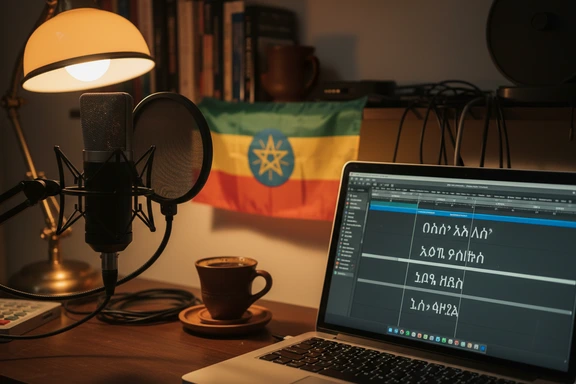
Content Creation & Diaspora Voiceover
Ethiopian creators in DC, Minneapolis, and London add Amharic narration to YouTube reviews, TikTok explainers, and podcast intros without booking a studio. Pick a male or female speaker, adjust the pace to match your edit, and drop the finished audio file straight into Premiere, DaVinci, or CapCut.
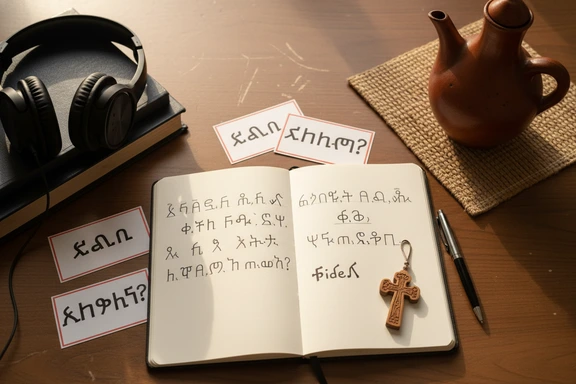
Amharic Language Learning & Pronunciation
Heritage children who read Fidel slowly, missionaries headed to Addis Ababa, and adopted families reconnecting with Ethiopian culture — all of them need to hear correct amharic pronunciation on repeat. Slow the playback to 0.75x to catch each ejective, then speed it back up once the sounds click.

Audiobooks & Storytelling
Amharic audiobooks barely exist — the market is wide open. Paste a chapter from a novel, a teret-teret folktale, or an Orthodox Tewahedo devotional text, choose a narrator voice, and export a finished audio chapter. Authors and small publishers can build a catalogue without renting a recording booth.
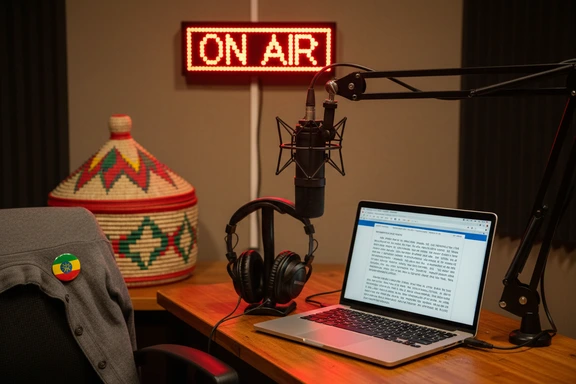
Public Announcements & Community Radio
Diaspora community centres, Ethiopian Orthodox churches, and health campaigns all need reliable Amharic audio on short notice. Type the announcement, pick a clear female or male presenter, and broadcast the result on community radio, church PA systems, or WhatsApp groups serving Ethiopian neighbourhoods abroad.
Amharic Text to Speech — How It Works
Three steps to turn Fidel script into spoken Ethiopian audio. No software to install, no account required.
Paste or type Amharic text
Open the editor and paste Fidel script — up to 1,000,000 characters. Mixed Amharic-Latin input works too. Upload DOCX, PDF, or SRT files if your text is already formatted.
Choose a voice
Pick from 47 Ethiopian speakers. Filter by gender, then fine-tune speed and pitch. Try Ameha for a warm narrator or Mekdes for a crisp female presenter.
Listen & download free
Click Convert to Speech, preview the result, and download as an audio file. First 1,000 characters free — no account needed. No watermark on any plan.
FAQ: Amharic Text to Speech
Yes. Export the audio file from the editor and send it as a voice message in Telegram, Discord, WhatsApp, or any other messenger. If you need automation, the SpeechGen service exposes an endpoint that lets your bot request Amharic audio on the fly — paste the text, receive a download link, and forward it to your chat.
There is. SpeechGen offers a web-based endpoint that accepts Amharic Fidel input and returns an audio file. You send text, voice name, speed, and pitch — the response includes a link to the generated recording. Documentation and example code are available in the developer section of the site.
Open-source projects like Piper TTS offer self-hosted Amharic models, but they typically ship a single male voice with limited phoneme coverage. SpeechGen provides 47 neural voices (male and female), handles ejective consonants and gemination out of the box, and requires no local hardware — just a browser. If you need full offline control and can accept lower quality, Piper is a fair alternative; for production-grade audio with zero setup, this tool is faster.
The code am-ET is the ISO locale tag for Amharic as spoken in Ethiopia — "am" for the language, "ET" for the country. Ge'ez (also called Fidel or Ethiopic) is the writing system used by Amharic, Tigrinya, and the liturgical Ge'ez language itself. This tool accepts Fidel input natively: paste ሰላም and it reads "Selam", no romanisation needed.
The first 1,000 characters are completely free — no account, no credit card, no watermark. Create a free account and the daily limit rises to 3,000 characters for seven days. Paid plans unlock longer texts, batch export, and higher monthly quotas, but commercial use is included even on the free tier.
Yes. Every plan — including the free tier — comes with a commercial licence. Download the audio file, drop it into your video editor or audiobook distributor, and publish. No attribution required, no watermark attached.
The neural voices are trained on native Ethiopian speech data, so ejectives (ቀ q', ጠ t', ጨ ch', ጰ p', ፀ ts') carry the characteristic glottal burst that distinguishes them from their non-ejective counterparts. Gemination — the doubling that changes meaning in words like አለ vs. አሌ — is also modeled. For the most natural result, paste text in Fidel rather than romanised form so the phoneme engine resolves each character accurately.