Georgian Text to Speech
Convert text to natural Georgian speech — 2 native voices, free MP3 download.
Native Georgian Neural Voices — Mkhedruli Script, Ejective Consonants & Kartvelian Phonology
Hear the name of a Kakheti village spoken with authentic ejective stops, a verse by Shota Rustaveli read in flowing Mkhedruli script, or a toast at a traditional supra feast turned into downloadable audio. Drop any text written in the 33-letter Georgian alphabet into the editor above and two native Kartuli speakers — Giorgi (male) and Eka (female) — will convert it to natural speech in seconds. Both voices handle the six ejective consonants, the three-way stop contrast, and the extreme consonant clusters that define Georgian pronunciation.
This is a language isolate of the Kartvelian family — no proven relationship to Indo-European, Turkic, or Semitic languages, and only three living relatives: Svan, Megrelian, and Laz. In addition to the two native speakers, SpeechGen provides 45 multilingual cross-language neural voices that can also read text in this language — useful when you need a specific voice character, though the native pair is recommended for authentic phonology including the uvular ejective and clusters of up to eight consonants in a row. Whether you need a Georgian voiceover for a Caucasus travel channel, a text to voice reader for Kartvelian Studies, or narration for a Tbilisi tourism audio guide, the full Georgian voice catalogue is one click away. Search "text to speech Georgian" or "Georgian TTS" — this page covers both.
- 47 voices — 2 native + 45 multilingual
- Neural tier throughout (Kartuli ka-GE)
- Adjustable speed & pitch
- Download MP3, WAV, OGG free
- First 1,000 characters — no signup
Georgian Voice Samples — Giorgi & Eka
Click to preview each native Kartuli voice · 47 speakers total
The two native Neural voices — Giorgi and Eka — pronounce authentic Kartvelian phonology, including the six ejective stops (კ ტ პ ჭ წ ყ), the aspirated/voiced three-way contrast, and extreme consonant clusters up to eight consonants in a row (e.g., გვფრცქვნის = 's/he peels us') that are unique to the Kartvelian family of South Caucasian languages. An additional 45 multilingual cross-language voices can also read text in this language when you need a specific voice character. Browse the full catalogue on the voices page — filter by ka-GE.
Georgian Pronunciation — Greetings, the Mkhedruli Alphabet & Ejective Stops
Seven essential phrases that demonstrate the sounds unique to this language. Click play to hear each one read by Eka.
Working with Georgian Text — Formatting & Conventions
How you format the source text affects the spoken output. Four conventions worth knowing when preparing content in Kartuli:
Mkhedruli Script Input
Paste directly in the Mkhedruli alphabet — no romanisation needed. The engine recognises all 33 letters, including the six ejective consonants კ ტ პ ჭ წ ყ and the aspirated set თ ქ ჩ.
Numbers
1,000 → “ათასი” — the engine reads Arabic numerals with correct Kartuli pronunciation. Georgian uses a vigesimal (base-20) counting system for some numbers, and the engine handles it automatically.
Punctuation
Standard punctuation works — the engine pauses correctly after periods, commas, and exclamation marks. Sentence-ending intonation follows the natural Kartuli pattern with a slight fall on declaratives.
Stress Pattern
Stress tends toward the initial syllable in shorter words and shifts in compounds and loanwords. No manual marking needed — both native neural voices apply context-sensitive stress rules automatically.
When to Use Georgian Text to Speech
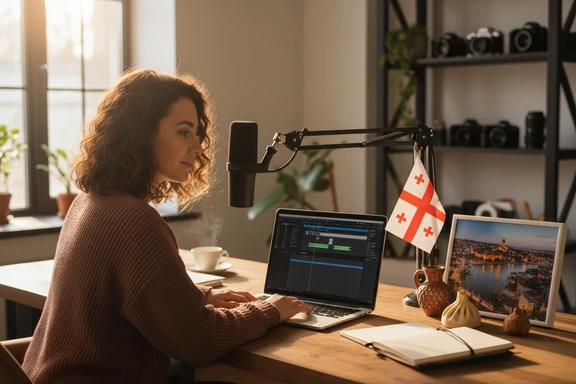
Content Creation & Voiceover
Add narration to travel vlogs about Kakheti wine country, khinkali-and-khachapuri food reels, or Caucasus hiking channels. Choose Giorgi for a deep broadcast tone or Eka for warm conversational delivery, adjust pacing, and export the audio file for any editing software.

Language Learning
Practice the Mkhedruli alphabet at adjustable speed, hear ejective-stop minimal pairs, and build listening fluency before a trip to Georgia or a Kartvelian Studies programme at Oxford, Jena, or Tbilisi State. Slow the playback to catch each consonant cluster, then speed it up once the pattern clicks.
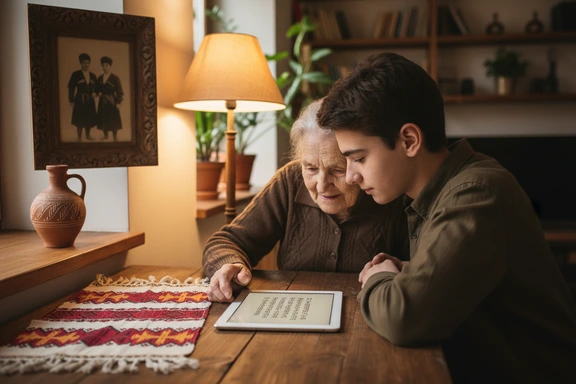
Diaspora & Heritage Connection
Roughly one million people of Georgian descent live outside the country — from Moscow to Brooklyn, Berlin to Tel Aviv. Third- and fourth-generation families who lost the spoken language can paste a grandparent's letter, a family recipe, or a supra toast and hear it read aloud in the Kartuli standard by a native voice.

Tourism & Heritage Audio Guides
Create spoken guides for Svetitskhoveli cathedral in Mtskheta, the cave city of Vardzia, Gergeti Trinity Church beneath Mount Kazbegi, or the qvevri cellars of Kakheti — where winemaking began eight thousand years ago. Export the audio file and embed it in a walking-tour app or museum kiosk.
Generate a Georgian AI Voice in 3 Steps
No software to install, no account needed for the first 1,000 characters.
Paste or type your text in Georgian
Type directly in the Mkhedruli alphabet or paste up to 1,000,000 characters. If your source is in English, run it through a machine translation tool first, then paste the result here to hear it spoken aloud.
Choose a voice
Pick from 47 speakers. Start with the two native voices — Giorgi (male) or Eka (female) — for the most authentic pronunciation of ejective consonants and consonant clusters. Adjust speed and pitch to match the tone you need.
Listen & download free
Click Convert to Speech, preview the result, and save as MP3 or WAV. The first 1,000 characters cost nothing and carry no watermark. Longer texts are available on paid plans with commercial use included.
What Makes Georgian Unique — 33 Letters, Ejectives & a Language Isolate Family
Mkhedruli Script & 33 Letters
The Mkhedruli alphabet (მხედრული, 'warrior script') is one of only 14 alphabets in active use worldwide. Each of the 33 letters maps to exactly one sound — perfectly phonetic. Together with its two predecessors, Asomtavruli and Nuskhuri, it holds UNESCO Intangible Cultural Heritage status since 2016. The flowing, rounded letterforms bear no visual resemblance to Latin, Cyrillic, Greek, Arabic, or Armenian scripts.
Ejective Consonants & Extreme Clusters
Six ejective consonants — კ ტ პ ჭ წ ყ — are produced with a closed glottis and a burst of compressed air. Add the three-way contrast of ejective, aspirated, and voiced stops, plus consonant clusters stretching up to eight consonants in a row (გვფრცქვნის), and you have one of the most demanding phonological systems for learners worldwide.
Kartvelian Family — a South Caucasian Isolate
With 3.7 million native speakers and an unbroken literary tradition from the 5th century, this language has no proven relationship to any other family — not Indo-European, not Turkic, not Semitic. Its only relatives are Svan, Megrelian, and Laz (spoken along the Black Sea coast). Grammar features include SOV word order, split ergativity, and polypersonal verbs that encode both subject and object in a single word.
Georgian Text to Speech — FAQ
Yes. SpeechGen offers two native Kartuli neural voices — Giorgi and Eka — plus 45 cross-language multilingual voices. The first 1,000 characters are free with MP3 download and no signup required. Paid plans unlock longer texts and commercial licensing.
Yes. Giorgi and Eka are trained on native Kartuli speech and reproduce the six ejective stops (კ ტ პ ჭ წ ყ) authentically, including the uvular ejective ყ and the three-way aspirated/voiced contrast. The 45 multilingual voices approximate these sounds through cross-language phoneme mapping — acceptable for general use, but native voices are recommended for teaching or publishing.
Yes. SpeechGen licensing covers commercial use including audiobooks, YouTube monetisation, podcasts, e-learning, and tourism audio guides. See the pricing page for plan details and character limits.
The ISO code is ka (Kartuli — the endonym; the country's autonym is საქართველო, Sakartvelo, 'land of the Kartvelians') and the locale code is ka-GE (Georgian, Georgia). Filter by ka-GE in the voice catalogue to see all 47 speakers.
No — this page provides text-to-speech only: you type or paste text and receive audio. For speech-to-text (transcription), consider Google Docs voice typing, which supports the ka-GE locale.
No. SpeechGen is a text-to-speech tool, not a translator. If you have English text, run it through Google Translate or DeepL first, then paste the resulting Kartuli text here to hear it spoken aloud. This workflow is used by Caucasus travelers, Kartvelian Studies students, and content creators daily.