Khmer Text to Speech
Convert text to natural Khmer speech — 47 AI voices, free MP3 download.
47 Neural Voices — Khmer Script, Two-Register System & Austroasiatic Heritage
Hear Cambodia’s Austroasiatic language spoken naturally — 47 neural speakers render the world’s longest alphabet (74 letters) with both phonation registers intact. Unlike its tonal neighbours Thai, Lao, and Vietnamese, Khmer uses a two-register system where voice quality shifts between clear and breathy rather than rising and falling pitch. Pick Piseth (neural, male) for a confident narration or Sreymom (neural, female) for a clear, warm read-aloud, and download the audio file in one click.
The catalogue serves content creators reaching the Cambodian diaspora in the United States, France, and Australia, heritage speakers reconnecting with the Mon-Khmer language of Angkor, tourists building audio guides for Siem Reap and Phnom Penh, and researchers working with Southeast Asian scripts. First 1,000 characters free, no account required.
- 47 native Cambodian voices — all Neural tier
- Two-register phonation handled natively
- Adjustable speed & pitch
- Download MP3, WAV, FLAC, OGG
- Free — 1,000 chars, no signup
Khmer Voice Samples — Click to Preview
Click to preview · 47 native voices total
These are 4 featured speakers — each a Cambodian neural voice trained on native pronunciation. Browse all 47 on the voices page — filter by km-KH. All Khmer voices are Neural-tier; studio-grade models for this Mon-Khmer language are not yet available.
Khmer Pronunciation — Greetings, Registers & the 74-Letter Alphabet
A reliable text to speech Khmer engine must handle subscript consonants, dependent vowels, and the two-register system accurately. Click play to hear each phrase spoken by a native neural voice and follow the transliteration.
What Makes This Language Sound Distinct
- Two registers, not tones — while Thai, Lao, and Vietnamese rely on pitch contour, Cambodian speech distinguishes meaning through phonation quality: the first register sounds clear and bright, the second breathy and lower. The voices reproduce both from the spelling alone.
- Subscript consonants — the Brahmic abugida uses “coeng” marks that attach below the main letter to form clusters like ស្ត or ង្គ. The engine parses these correctly, avoiding flat letter-by-letter output.
- Pali-influenced vocabulary — roughly 60 percent of formal words come from Pali and Sanskrit, the classical languages of Theravada Buddhism. The voices preserve the ceremonial register, which matters for religious and academic narration.
When to Use Khmer Text to Speech
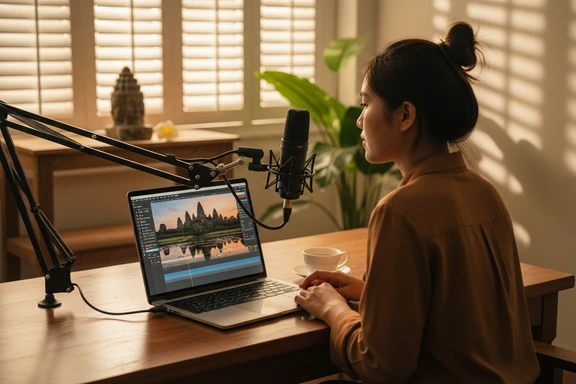
Content Creation & Voiceover
Record a native Cambodian voiceover for YouTube travel vlogs, diaspora channels, or cultural documentaries about Angkor heritage. Choose a conversational speaker and export the audio file for Premiere, DaVinci, or CapCut — no studio session needed.
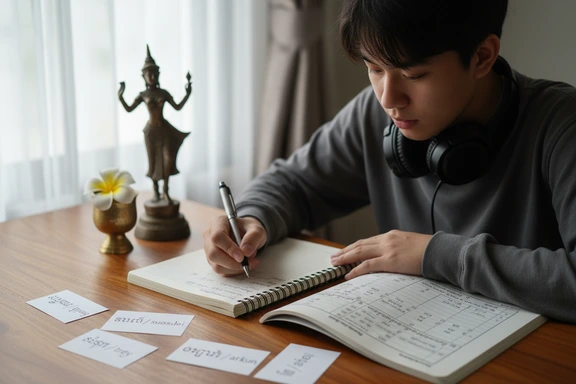
Khmer Language Learning
Drill the 74-letter alphabet and the two-register system before a field trip or heritage visit. Paste vocabulary lists, slow playback to 0.75×, and compare your own recording with the neural reader. Useful for Southeast Asian Studies courses, NGO worker preparation, and heritage speakers reconnecting with the language of Angkor.
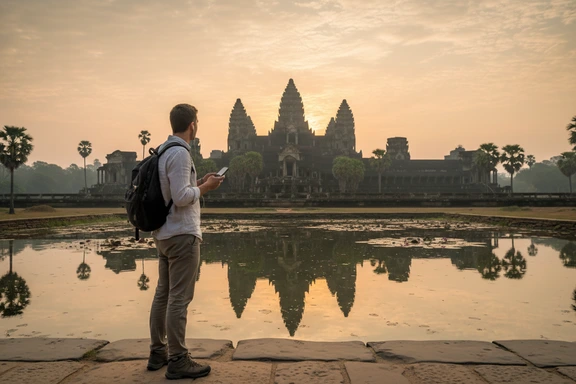
Tourism & Heritage Audio Guides
Create a walking-tour narration for Angkor Wat, Bayon, Ta Prohm, the Royal Palace in Phnom Penh, or Tonle Sap floating villages. Visitors hear place names and context in natural Cambodian speech on their own phone — no human guide required.

Cross-Border & Diaspora Business
Voice a quarterly report, safety briefing, or onboarding deck for Cambodian staff across the Mekong corridor. Export the audio file and embed it in PowerPoint, Google Slides, or internal training platforms — clear articulation in a formal register for cross-border commerce.
Generate a Khmer Voice in 3 Steps
Three steps from typed text to speech. No software, no signup.
Paste or type your text
Type directly or paste up to 1,000,000 characters of Khmer script. Upload DOCX, PDF, or SRT files. Works with any content — scripts, articles, study notes, Buddhist texts.
Choose a Cambodian voice
Pick from 47 native speakers. Filter by gender. Adjust speed and pitch to match the tone you need, from a calm read-aloud to an energetic voiceover.
Listen & download free
Click Convert to Speech, preview the result, and download as MP3, WAV, or FLAC. That is all a Khmer TTS session takes. First 1,000 characters free — no account needed. No watermark on any plan.
What Makes Khmer Unique — Longest Alphabet, Two Registers & Pali Heritage
World’s Longest Alphabet — 74 Letters
Khmer script holds the Guinness record for the longest alphabet: 33 consonants, 24 dependent vowels, 12 independent vowels, plus diacritics and subscripts. It is a Brahmic abugida descended from the Pallava script of southern India (6th century CE), arriving via ancient trade routes with Funan and early Angkor. Subscript consonants called coeng attach below the main letter to form clusters. The same letterforms appear in 12th-century Angkor Wat inscriptions — over 1,400 years of continuous use. The engine handles subscripts, dependent vowels, and diacritic combinations correctly.
Two-Register System Instead of Tones
Khmer is not a tonal language — extraordinary in Southeast Asia, where Thai (5 tones), Lao (6), Vietnamese (6), and Burmese (4) all rely on pitch contour. Instead, Cambodian speech uses a two-register phonation system: the first register (clear, historically voiceless consonants) and the second register (breathy, historically voiced). The same written consonant with the same vowel produces different vowel qualities depending on its inherent register. This rare Austroasiatic feature sets the language apart from every other major Southeast Asian tongue. The voices render both registers naturally from the spelling.
Pali/Sanskrit Heritage & Theravada Buddhism
Around 60 percent of formal vocabulary is borrowed from Pali or Sanskrit — the classical languages of Indian civilization and Theravada Buddhism. Religious, philosophical, and academic terms are almost entirely Indic in origin. The name Piseth (ពិសិដ្ឋ) means “sacred” in this tradition, derived from Pali visiṭṭha. Sreymom (ស្រីមុំ) means “young lady” — a classical feminine name. The engine preserves the formal Pali pronunciation for Buddhist texts and everyday pronunciation for modern Cambodian speech.
Khmer Text to Speech — FAQ
“Khmer” is the name of the language and the ethnic group — it is the preferred term in linguistics and among native speakers. “Cambodian” is the demonym for people and things from Cambodia, the country. Both words refer to the same Austroasiatic language spoken by roughly 17 million people. This page offers Cambodian text to speech — paste any content written in Khmer script and hear it read aloud.
The ISO 639-1 code is km. The full IETF BCP 47 tag used by browsers and speech engines is km-KH (Khmer as spoken in Cambodia). SpeechGen uses that tag internally. Filter the voice catalogue by the code to see all available speakers.
No. Khmer is not tonal — a rare feature in Southeast Asia where Thai, Lao, Vietnamese, and Burmese all use pitch to distinguish meaning. Instead, Cambodian speech relies on a two-register phonation system: clear voice quality (first register) versus breathy quality (second register). Listen to the register-contrast demo in the pronunciation table above.
Yes. Every Khmer AI voice, including the free tier, comes with a commercial licence. You may use the generated audio in documentaries, e-learning courses, audiobooks, podcasts, business presentations, Angkor tourism guides, and any other project. No watermark is added.
No. This is a text to speech tool — it converts written Cambodian content into audio, not audio back into text. Paste your content, choose a voice, and download the audio file.