Urdu Text to Speech — Indian Hindustani Voice
Convert text to natural Indian Urdu speech — male & female AI voices, free.
4 Urdu AI Voices — Lucknowi, Dehlavi & Hindustani Tones
Urdu and Hindi share the same spoken core — Hindustani — yet Urdu wraps it in the elegant Nastaliq script and draws on centuries of Persian and Arabic literary vocabulary. From the ghazals of Mirza Ghalib to modern Bollywood lyrics, this register carries a softer, more lyrical cadence than its broadcast-formal counterpart. Paste any Nastaliq text below to convert it to natural Indian Urdu speech: two native voices trained on the Lucknowi-Dehlavi register plus two alternative tones for tonal variety. Text to speech Urdu has never sounded this close to a real Hindustani speaker.
The tool works as an urdu text reader for heritage families who want children to hear classical verse read aloud, as a voiceover engine for Bollywood and qawwali content creators, and as a pronunciation aid for university students studying Mir Taqi Mir or Faiz Ahmed Faiz. Diaspora speakers who need a quick urdu audio version of any Nastaliq document can generate the file, download it as urdu mp3, and use it in any project — free, no signup required.
- 4 Urdu AI voices — 2 native Indian (Lucknowi/Dehlavi register), 2 alternative tones
- Soft Hindustani cadence — Bollywood & qawwali ready
- Reads Nastaliq script natively — no transliteration needed
- Free urdu text to speech — no signup, no watermark
- Fast generation — one click, any device, instant urdu voice over
Indian Urdu AI Voices — Male & Female
Click to preview · 4 Urdu voices
Salman and Gul are native Indian urdu speaker voices (ur-IN) with a Lucknowi-Dehlavi register. Adam and Ada provide alternative tones for additional timbral variety. All four are Neural PRO — the same quality tier used by professional urdu voiceover producers.
Urdu Phonetic Highlights
Six phrases that showcase urdu pronunciation highlights. Click play to hear each one — the tts urdu engine handles retroflex consonants, nasal vowels, and uvular sounds natively.
What Makes Indian Urdu Sound Distinctive
- Retroflex consonants — sounds like ٹ (retroflex t), ڈ (retroflex d), and the retroflex flap ڑ are Indo-Aryan additions absent from standard Arabic. The tongue curls back to the palate, producing a heavier tap that defines the Hindustani rhythm.
- Aspirated stops — pairs like پھ (ph), بھ (bh), تھ (th), and دھ (dh) carry a puff of air that distinguishes meaning. Missing the aspiration changes the word entirely.
- Nasal vowels & ezafe — the nun-ghunna (ں) nasalises the preceding vowel, and the ezafe particle links noun phrases in a flowing chain typical of classical verse. Any urdu text to voice conversion must get these right, or the reading sounds robotic instead of Hindustani.
Urdu Text Formatting — Tips for Better Readings
How you format the source text affects the spoken output. Four conventions worth knowing when preparing Nastaliq input:
Numbers
“۱۲۳” → “ek sau teis” — the engine reads Eastern Arabic numerals natively. For Western digits, wrap them in context: “15 din” reads as “pandrah din” (fifteen days).
Currency
“₹500” → “paanch sau rupaye” — the rupee sign is recognised automatically. For international amounts, spell out the currency name in Nastaliq for cleaner output.
Script Direction
Nastaliq runs right to left. Paste the text as-is — the reader handles bidirectional flow. Embedded Latin words (brand names, URLs) are read left to right within the sentence automatically.
Punctuation & Pauses
Use ۔ (Urdu full stop) for natural pauses. A comma produces a shorter breath. For verse, add a line break between each misra (hemistich) to preserve the meter of a ghazal couplet.
Use Cases: Indian Urdu Voice in Action
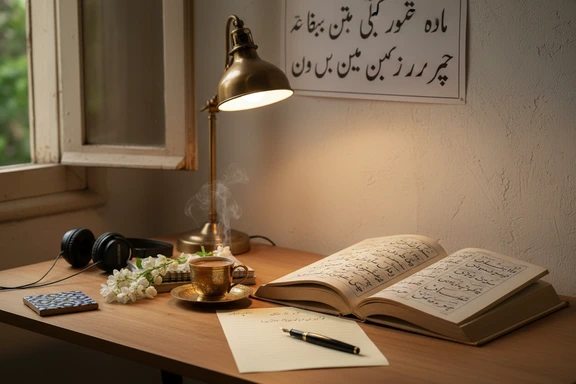
Heritage & Language Learning
Diaspora children who speak English at school can hear classical couplets and everyday phrases read in a native Hindustani register. This urdu reader slows playback to 0.75x so learners catch every aspirated consonant, then replays at normal speed. Equally useful for university courses and civil-service exam preparation in India.
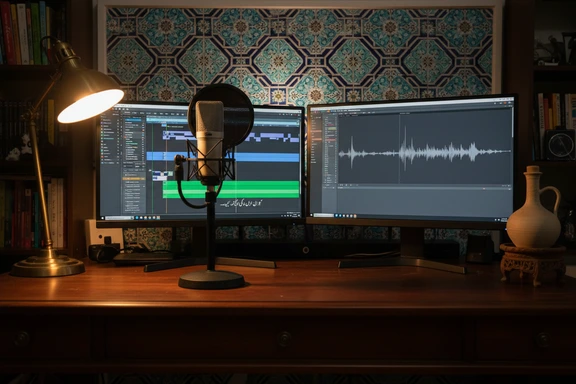
Content Creation & Voiceover
Add an Indian urdu speaking voice to YouTube documentaries about Lucknow, Bollywood lyric breakdowns, qawwali playlists, or Mughal-history shorts. Export the audio file and drop it into Premiere, DaVinci, or CapCut. This urdu ai voice fits both formal narration and casual reels with its warm Hindustani cadence.
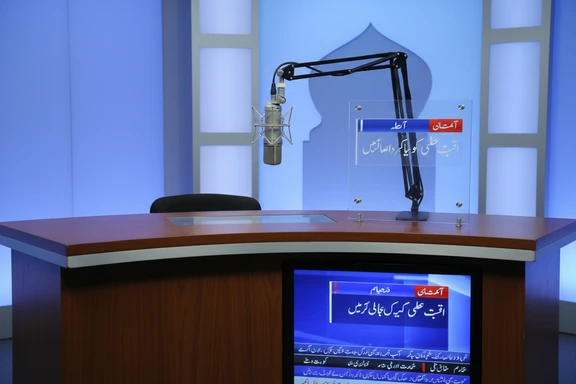
Media, News & Community Broadcasts
Produce community bulletins, weekly announcements, and public-service messages for Urdu-speaking audiences. A consistent voice anchors diaspora radio segments and masjid newsletters. Upload once and distribute across podcast platforms, WhatsApp groups, or local FM streams.
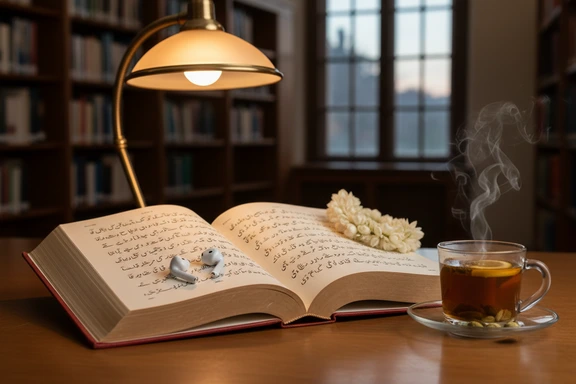
Audiobooks, Poetry & Narration
Turn a ghazal by Mirza Ghalib or a short story by Saadat Hasan Manto into a listening experience. Use slower speed for classical verse so the meter breathes, and natural pace for prose. Ideal for heritage audiobooks that diaspora families can share with children who read English but want to hear the original cadence of Mir Taqi Mir.
How It Works — Urdu TTS in 3 Steps
Three steps to generate Indian Urdu audio online. Free tts urdu — no software, no signup.
Paste your Urdu Nastaliq text
Type directly or paste up to 1,000,000 characters of right-to-left Nastaliq script. Upload DOCX, PDF, or SRT files. The reader handles bidirectional text automatically.
Choose a voice
Pick Salman or Gul for native Indian Hindustani, or select an alternative tone for variety. Adjust speed and pitch to match your project—slower for poetry, faster for news reads.
Download free — no signup
Click Convert to Speech, preview the result, and download your audio file. First 1,000 characters free with no account and no watermark.
Urdu Language Spotlight (India)
Key facts about Indian Urdu that shape how the text-to-speech engine handles this language.
- One of 22 official languages of India — co-official in Uttar Pradesh, Bihar, Telangana, and Delhi. Roughly 50 million speakers in India use it as a first or literary language. Bollywood, the world’s largest film industry, draws heavily on Urdu vocabulary for its song lyrics and dialogue.
- The Hindustani continuum — spoken Hindi and spoken Urdu share virtually the same grammar and everyday vocabulary. The split is in script (Devanagari vs Nastaliq) and in higher-register words borrowed from Sanskrit (Hindi) or Persian and Arabic (Urdu). A TTS engine reading Urdu text must handle the Persian-origin vocabulary and Nastaliq ligatures correctly.
- Nastaliq script — a calligraphic right-to-left script with 38–40 letters. It adds Indo-Aryan characters for retroflex and aspirated sounds (ٹ ڈ ڑ ں ھ) that do not exist in Arabic. The flowing vertical baseline distinguishes Nastaliq from the flatter Arabic naskh and makes it one of the most visually distinctive writing systems in the world.
- Classical poets — Mir Taqi Mir (18th century, often called the father of the ghazal), Mirza Ghalib (19th century, Delhi), Allama Iqbal, Faiz Ahmed Faiz, and Sahir Ludhianvi (whose lyrics bridged classical verse and Bollywood). Hearing their couplets read aloud is one of the most popular uses of Urdu text to speech among heritage speakers.
- Ghazal and qawwali tradition — the ghazal is a poetic form built around rhyming couplets and a refrain (radif). Qawwali, the Sufi devotional music tradition, relies on Urdu lyrics sung in a lyrical, melismatic register. Both demand a softer, more musical speaking tone than formal broadcast style—exactly the cadence the Indian ur-IN voices reproduce.
- Challenges for text to speech — distinguishing /gh/ (غ) from /g/ (گ), rendering aspirated stop pairs (پھ بھ تھ دھ), the retroflex flap ڑ, nasal vowels via nun-ghunna (ں), and the ezafe particle that joins noun phrases in flowing chains. These phonetic details define whether an urdu text reader sounds authentically Hindustani or generically robotic.
FAQ: Urdu Text to Speech
The spoken core is almost identical—both descend from Hindustani. Indian Urdu tends toward a softer, more lyrical register shaped by Bollywood lyrics, qawwali, and the literary tradition of Lucknow and Delhi. The vocabulary borrows more freely from Hindi. The formal broadcast standard heard on Pakistani television is somewhat more conservative, drawing on a larger Persian-Arabic lexicon. SpeechGen offers separate pages for each: this page focuses on Indian Hindustani voices, while Urdu Text to Speech (Pakistan) covers the broader Urdu voice catalogue.
Yes. Salman and Gul are trained on the Indian ur-IN register—the same cadence Bollywood playback singers and film narrators use. They handle ghazal couplets, qawwali lyrics, and conversational dialogue naturally. Lower the speed to 0.85x for a more dramatic reading, or keep it at 1.0x for everyday narration.
This tool reads Nastaliq (right-to-left) script. If you have text written in Devanagari, use the Hindi Text to Speech page instead—the spoken output is almost identical because Hindi and Urdu share the Hindustani spoken base, but the engines are optimised for their respective scripts.
Paste your Nastaliq text into the editor above, pick a voice (Salman for male, Gul for female), and click Convert to Speech. This urdu text to speech ai tool gives you 1,000 characters free with no account and no watermark. Download the audio file and use it in any project.
Absolutely. For classical verse, reduce the speed to 0.75x–0.85x so the meter has room to breathe. Add a line break between each misra (hemistich) for a natural pause at the caesura. The Indian voices handle the uvular /gh/ and nasal vowels that define the musicality of a Ghalib or Mir Taqi Mir couplet.