Azerbaijani Text to Speech
Convert text to natural Azerbaijani speech — 50+ AI voices, free MP3.
50+ Azerbaijani Neural Voices — Latin Script, Schwa (ə) & Turkic Vowel Harmony
Baku-accented Azerbaijani with correct vowel harmony and the soft ə that defines modern Azeri — powered by neural voices trained on native speakers. The most popular speaker, Babek, handles news readings, business narration, and content voiceover with clear intonation and correct vowel harmony. Banu, the native female neural voice, is ideal for learning materials and public announcements. Both deliver text to speech Azerbaijani learners and content creators rely on, rendering the distinctive ə (schwa) that sets this language apart from its Turkic relatives.
Beyond the two native speakers, the catalogue includes multilingual neural voices like Ada AZ and Isabella AZ that read Azerbaijani with a slight international colour — useful for bilingual projects spanning Azerbaijan and neighbouring countries, giving you a versatile Azerbaijani AI voice for any production context. Adjust speed and pitch per voice, preview instantly, and download your file free. No signup, no watermark on any plan.
- 53 voices — 2 native + 51 multilingual Neural
- Latin-script input (post-1991 alphabet)
- Adjustable speed & pitch
- Download MP3, WAV, OGG, FLAC
- Free — 1,000 chars, no signup
Azerbaijani Voice Samples — Babek, Banu & Multilingual AI
Click to preview · 53 Azerbaijani voices total
These are 4 featured speakers. Browse all 53 on the voices page — filter by az-AZ.
Azerbaijani Pronunciation — the ə Sound, Dotless ı & Soft Consonants
Hear how the text-to-speech engine handles the sounds that make this Turkic language distinctive. Click play on each phrase.
What Makes Azerbaijani Sound Unique
- The ə vowel (schwa) — the most recognisable feature. It appears in everyday words like nəzər (attention) and gəl (come). Modern Turkish lacks this letter entirely, so it serves as the clearest audio marker separating the two sibling languages.
- Vowel harmony — suffixes shift between front and back vowels to match the root word. evlər (houses) uses front vowels, while yollar (roads) uses back vowels. The engine applies these rules automatically when generating speech.
- Soft consonants ç, ş, ğ — ç sounds like ch in English, ş like sh, and ğ silently lengthens the preceding vowel. Correct handling of ğ in words like dağ (mountain) is a key quality test for any text-to-speech engine.
Azerbaijani Latin Script — Formatting Tips
Small formatting details in the source text affect how the voice reads aloud. Four conventions to keep in mind:
Numbers
1 520 → “min beş yüz iyirmi” — Azerbaijani uses space as a thousands separator. The engine reads multi-digit numbers with correct Turkic numeral grammar, including vowel-harmony suffixes on ordinals.
Currency
₼25.50 → “iyirmi beş manat əlli qəpik”. Use the manat symbol ₼ or write “AZN” and the reading comes out naturally, with correct decimal handling for qəpik (sub-unit).
Dates
15 aprel 2026 → “on beş aprel iki min iyirmi altı”. Day-first format with lowercase month name. Year reads as a full number, not digit-by-digit.
Special Characters
ə, ı, ö, ü, ç, ş, ğ, x — these eight letters distinguish Azerbaijani Latin from Turkish Latin. Always use proper Unicode characters rather than ASCII substitutes; e instead of ə changes pronunciation entirely.
When to Use Azerbaijani TTS
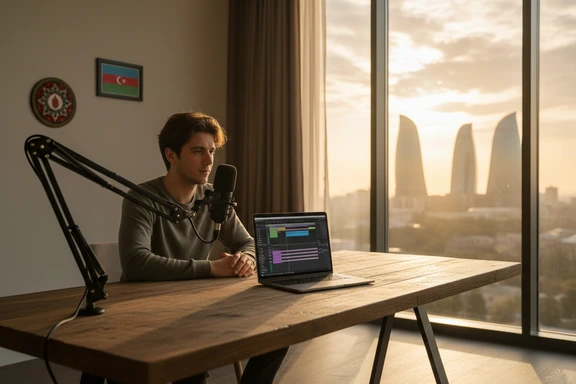
Content Creation & Voiceover
Add a natural Azerbaijani voiceover to YouTube videos, TikTok clips, and social-media reels aimed at audiences in Baku and across the Caspian region. Pick Babek for a confident male narrator or Banu for a clear female read, export as an audio file, and drop it into any video editor.

Language Learning & Pronunciation
Practice the ə vowel, soft ğ, and Turkic vowel patterns with a native speaker at any playback speed. Slow the reading to 0.75× to catch every sound, then speed it back up once you follow along. Particularly helpful for Turkish speakers exploring their closest linguistic relative.

Audiobooks & Narration
Turn manuscripts and short stories into audio with a warm Azerbaijani narrator. Works well for classic literature — Nizami Ganjavi, Füzuli, and contemporary Azeri prose. Use Dialog Mode to assign Babek and Banu to different characters for a two-voice production.

Business Presentations
Voice quarterly reports, training modules, and investor decks in Azerbaijani for companies operating across the Caspian corridor. The professional tone of Babek fits corporate narration, while multilingual voices like Ada AZ bridge bilingual presentations that mix Azerbaijani and English sections.
How to Generate an Azerbaijani Voice in 3 Steps
Turn any Latin-script text into natural Azerbaijan text to speech in three steps. No software, no signup.
Paste or type your Azerbaijani text
Type directly or paste up to 1,000,000 characters in Latin-script Azerbaijani. Upload DOCX, PDF, or SRT files. Make sure the text uses proper ə, ı, ö, ü characters for accurate pronunciation.
Choose an Azerbaijani voice
Pick from 53 speakers. Start with Babek (native male) or Banu (native female) for the most authentic Baku reading. Filter by az-AZ in the voice list, then adjust speed and pitch to fit your project.
Listen & download free
Click Convert to Speech, preview the result, and download as MP3 or WAV. First 1,000 characters free — no account needed. No watermark on any plan, commercial use included.
What Makes Azerbaijani Distinctive — Turkic Roots, Latin Revival
A few features that matter when preparing text for Azerbaijani read-aloud:
Latin Script Since 1991
After sixty years under Cyrillic, Azerbaijan restored the Latin alphabet in 1991. The current 32-letter script includes ə, ı, ö, ü, ç, ş, ğ, and x. All text input must be Latin — Cyrillic text is not processed. If your source is in the old alphabet, convert it first.
Sister of Turkish
Azerbaijani and Turkish are closely related Turkic languages with roughly seventy to eighty percent mutual intelligibility. They share agglutinative grammar and vowel harmony, but differ in key sounds: the ə vowel, the velar x, and certain vocabulary (Azerbaijani necə versus Turkish nasıl for “how”).
Vowel Harmony in Practice
Every suffix adapts its vowels to match the root word. This means a single noun can surface with different endings depending on context: ev-də (in the house) but yol-da (on the road). The speech engine handles these alternations automatically when it parses the input text.
Azerbaijani Text to Speech — FAQ
53 voices in total. Two are native Azerbaijani Neural speakers — Babek (male, the most popular azeri voice on the platform) and Banu (female). The remaining 51 are multilingual Neural voices that read Azerbaijani text with varying degrees of international colour. All voices support speed and pitch adjustments.
No. The engine processes Latin-script Azerbaijani only — the 32-letter alphabet adopted in 1991. If your text is in the older Cyrillic script, convert it to Latin first using any standard converter, then paste the result here for read aloud.
Strictly a reader. Paste text already written in Azerbaijani and the tool reads it aloud with a natural voice. It does not translate between languages. If you need an English-to-Azerbaijani translation, use a separate service first, then bring the result here to generate the audio.
Yes. Commercial use is included in every tier, including the free one. Generate an Azerbaijani voiceover for a YouTube channel, corporate presentation, or e-learning course and publish it without additional licensing. No watermark on any plan.
They are sibling languages from the Turkic family and share most grammar, but the phonetic systems differ. Azerbaijani uses the ə (schwa) vowel and the velar x sound that modern Turkish does not have. If you need Azerbaijani pronunciation, choose an az-AZ voice — a Turkish voice will mispronounce these distinctive sounds.