Burmese Text to Speech
Convert text to natural Burmese speech — 47 AI voices, free MP3 download.
47 Neural Voices — Burmese Round Script, Four Tones & Sino-Tibetan Phonology
Hear Myanmar’s tonal Sino-Tibetan language spoken naturally — all four contours rendered from the round Brahmic script that scribes carved into palm leaves centuries ago. The library covers 47 neural speakers trained on native pronunciation, so greetings like mingalaba (“auspicious”) land with the correct creaky and high tones. Pick Thiha (neural, male) for a confident narration or Nilar (neural, female) for a clear, warm read-aloud and download the audio file in one click.
Whether you are building heritage content for the Myanmar diaspora, recording a Bagan temple audio guide, drilling the four tones before a trip, or adding a voiceover to a documentary set in Yangon, the catalogue spans conversational to formal registers. First 1,000 characters free, no account required.
- 47 native Myanmar voices — all Neural tier
- Four-tone system handled natively
- Adjustable speed & pitch
- Download MP3, WAV, FLAC, OGG
- Free — 1,000 chars, no signup
Burmese Voice Samples — Click to Preview
Click to preview · 47 native voices total
These are 4 featured speakers — each a Burmese AI voice trained on native tones. Browse all 47 on the voices page — filter by my-MM. Studio-grade models for this Sino-Tibetan language are not yet available; all voices are Neural-tier.
Burmese Pronunciation — Greetings, Tones & the Round Script
Any reliable text to speech engine must handle these sounds accurately. Click play to hear each phrase spoken by a native neural voice and follow the transliteration.
What Makes This Language Sound Distinct
- Four tones — creaky (short glottal constriction), low (flat), high (falling), and checked (glottal-stopped). A single syllable can carry any of the four, changing meaning entirely. The voices reproduce each contour from the spelling alone.
- Stacked consonants — Burmese script uses vertical stacks and medial marks ( ျ ြ ွ ) to represent clusters like my- or gy-. The engine reads these correctly, avoiding the flat letter-by-letter output of simpler readers.
- Pali-influenced vocabulary — roughly 40 percent of formal words come from Pali, the liturgical language of Theravada Buddhism. The voices preserve the ceremonial register, which matters for religious and academic narration.
When to Use Burmese Text to Speech

Content Creation & Voiceover
Record a native Myanmar voiceover for YouTube travel vlogs, diaspora channels, or cultural documentaries. Choose a warm conversational speaker and export the audio file for Premiere, DaVinci, or CapCut — no studio session needed.
Language Learning
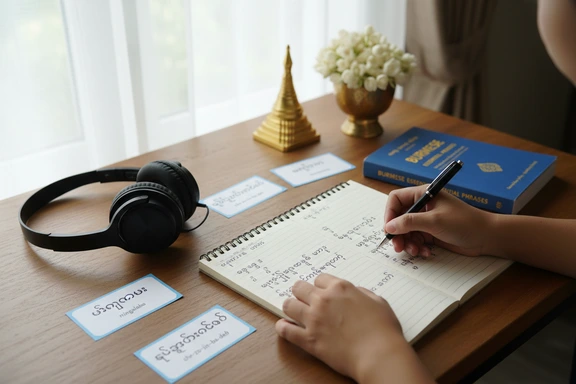
Drill the four tones and stacked consonants before a field trip or heritage visit. Paste vocabulary lists, slow playback to 0.75×, and compare your own recording with the neural reader. Useful for Southeast Asian Studies courses, missionary prep, and heritage speakers reconnecting with the language.

Tourism & Heritage Audio Guides
Create a walking-tour narration for Bagan’s temple plains, Shwedagon Pagoda, Inle Lake, or Mandalay Palace. Visitors hear place names and context in natural Myanmar speech on their own phone — no human guide required.

Cross-Border & Diaspora Business
Voice a quarterly report, safety briefing, or onboarding deck for Myanmar staff in Thailand, Singapore, or the UK. Export the audio file and embed it in PowerPoint, Google Slides, or internal training platforms — clear articulation in a formal register.
Generate a Burmese Voice in 3 Steps
Three steps from typed text to speech. No software, no signup.
Paste or type your text
Type directly or paste up to 1,000,000 characters of Myanmar script. Upload DOCX, PDF, or SRT files. Works with any content — scripts, articles, study notes, religious texts.
Choose a voice
Pick from 47 native speakers. Filter by gender. Adjust speed and pitch to match the tone you need, from a calm read-aloud to an energetic voiceover.
Listen & download free
Click Convert to Speech, preview the result, and download as MP3, WAV, or FLAC. That is all it takes to turn text to speech in any register. First 1,000 characters free — no account needed. No watermark on any plan.
What Makes Burmese Unique — Round Script, Four Tones & Pali Loanwords
Round Script from Mon
The distinctly circular letters evolved because ancient scribes wrote on palm leaves — straight lines would tear the surface. The alphabet descends from Mon, which itself came from the Pallava script of South India. 33 consonants, 12 basic vowels, and several tone marks combine into syllable blocks. The engine parses medial consonants and modifier positions correctly.
Four Tones
Every syllable carries one of four tones: creaky (short glottal constriction), low (flat), high (falling or rising-falling), and checked (glottal-stopped). Fewer than Thai’s five or Lao’s six, but equally meaningful. The classic learning example: “ma” changes from “hard” to “aunt” to a question particle depending on tone.
Pali Loanwords & Honorific Particles
About 40 percent of formal vocabulary is borrowed from Pali, the liturgical language of Theravada Buddhism. Religious, philosophical, and academic texts rely heavily on these terms. Honorific particles like pa, shi, and thi shift sentence register from casual to deferential. The voices preserve the formal Pali pronunciation when reading Buddhist and ceremonial texts.
Burmese Text to Speech — FAQ
“Burmese” is the traditional English name for the language, while “Myanmar” is the official country name adopted in 1989. “Burma” is the older English name for the country. In linguistics both terms refer to the same Sino-Tibetan tonal language spoken by roughly 33 million people. This page offers text to speech — paste any content written in Myanmar script and hear it read aloud.
The ISO 639-1 code is my. The full IETF tag used by browsers and speech engines is my-MM. Most Burmese TTS services, including this one, use that tag internally. Filter the voice catalogue by the code to see all available speakers.
Four: creaky (short with glottal constriction), low (flat), high (falling or rising-falling), and checked (glottal-stopped). All four contours are rendered correctly from the spelling — listen to the tone-contrast demo in the pronunciation table above.
Yes. Every plan, including the free tier, includes a commercial licence. You may use the generated audio in documentaries, e-learning courses, audiobooks, podcasts, business presentations, and any other project. No watermark is added.
No. This is a text to speech tool for written Myanmar content — it does not transcribe spoken audio back into text. Paste your content, choose a voice, and download the MP3.