South African Accent Generator
3 native South African English voices — authentic Saffa accent, free MP3.
3 Native en-ZA Voices — Cape Town, Johannesburg & Durban English
South Africa has eleven official languages, yet its English carries one of the most recognisable accents in global media — think broadcast news from Johannesburg, wildlife documentaries filmed in the Kruger, or comedy specials rooted in Cape Town slang. The SA accent blends British-inherited non-rhotic features with locally-influenced vowel shifts, a distinctive KIT-split, and a vocabulary peppered with words like howzit, lekker, and eish. These three neural en-ZA speakers — Luke, Ayanda plus, and Leah — capture the General South African register used in everyday Saffa conversation.
Paste any English paragraph and the reader converts it into natural South African speech with the rolled consonants and clipped vowels that mark this accent apart from British or Australian variants. Useful for content creators building a Safari-themed channel, narrators recording African literature, game designers who need a Joburg hustler or Durban surfer character, and language learners training their ear on a non-rhotic accent that sits between Received Pronunciation and Broad Australian. First 1,000 characters free, no account needed.
- 3 native en-ZA voices — all Neural tier
- Male & female speakers
- Adjustable speed & pitch
- Download MP3, WAV, OGG, FLAC
- Free — 1,000 chars, no signup
South African Accent Voices — Listen to Saffa Samples
Click to preview · 3 native en-ZA voices total
These are all 3 en-ZA speakers available on the platform. Browse additional English accents on the voices page — filter by en-ZA.
South African vs British — Pronunciation Comparison
South African English shares its non-rhotic base with British RP, but vocabulary and vowel quality set the two apart. Click play to compare side by side.
What Makes South African English Sound Unique
- KIT-split — the short /ɪ/ vowel splits into two distinct sounds depending on syllable position. Words like “kit” and “bit” sit higher in the mouth than in RP, making them instantly recognisable.
- Non-rhotic with a twist — like British RP, post-vocalic /r/ is dropped (“car” = /kɑː/), but some speakers roll their /r/ at the start of words, influenced by local languages.
- Flat TRAP vowel — the /æ/ in words like “cat” and “man” sounds flatter and more forward than both British and Australian realisations, giving the accent its signature warmth.
South African English — Formatting & Conventions
Format your source text with these conventions for natural-sounding output:
Slang
"howzit" (hello), "lekker" (nice/great), "eish" (surprise), "shame" (sympathy, not embarrassment), "just now" (soon, not immediately), "now-now" (very soon).
Spelling
colour, favour, organise, realise — SA English follows British spelling conventions, not American. Use “programme” for broadcasts and “programme” for events.
Dates
15/01/2026 → “the fifteenth of January twenty twenty-six”. Day-first format, same as the UK and Australia.
Currency
R49.99 → “forty-nine rand ninety-nine”. Use the R symbol; the engine reads it as “rand” automatically.
How People Use a South African Voice
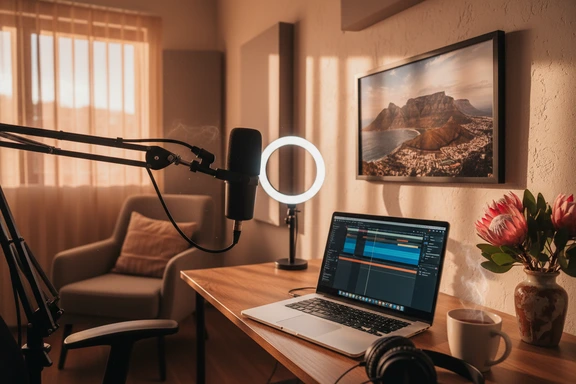
Content Creation & Voiceover
Add a South African speaker to travel vlogs, safari channels, and food reviews. The warm rolling intonation lifts any voiceover — record once, export as audio, and drop the file into Premiere, DaVinci, or CapCut.

Audiobooks & Narration
Bring Karoo sagas, township stories, and African folktales to life with a native narrator. Switch characters through pitch and speed, and let listeners hear every scene as it was meant to sound. Ideal for Deon Meyer novels and indie short-story collections.
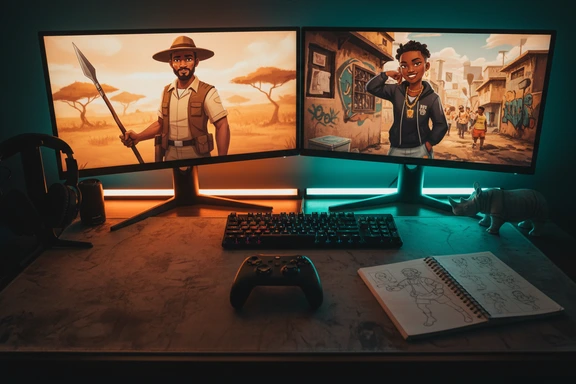
Character Voices & Gaming
Cast a seasoned ranger, a streetwise Joburg hustler, or a no-nonsense game warden. Shift pitch for villains, slow down for quiet moments — the SA accent gives characters instant personality in games, animation, and tabletop campaigns.
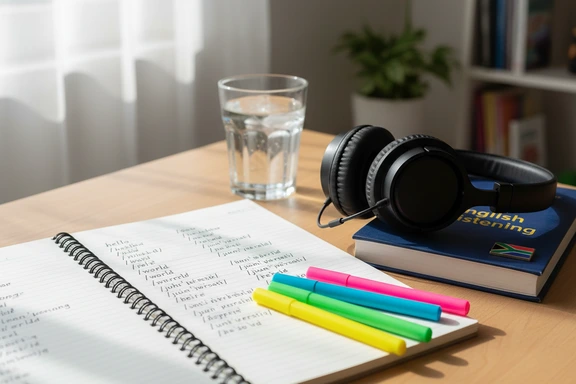
Language Learning & Pronunciation
Hear exactly how South African English sounds — the rolled consonants, the clipped vowels, the rising intonation. Play each phrase, slow it down, and repeat until your ear catches every nuance. A practical way to prepare for real conversations with speakers from South Africa.
How to Generate a South African Accent Voice
Three steps to convert English text to speech with a South African accent online. No software, no signup.
Paste or type your text
Open the editor above and paste up to 1,000,000 characters. Upload DOCX, PDF, or SRT files. Works with any English text — scripts, articles, dialogue, study notes.
Choose an en-ZA voice
Pick from 3 native speakers: Luke (male), Ayanda plus (female), or Leah (female). Filter by en-ZA in the voice dropdown, then adjust speed and pitch to fine-tune the reading.
Listen & download free
Click Convert to Speech, preview the result, and download as MP3, WAV, or FLAC. First 1,000 characters free — no account needed. No watermark on any plan.
Frequently Asked Questions
Yes. The first 1,000 characters are free with no account and no watermark. Create a free account for an additional 3,000 characters per day for seven days. Commercial use is included in every tier, including the free one.
Three Neural speakers: Luke (male), Ayanda plus (female, most popular), and Leah (female). All three are trained on native South African English pronunciation. Speed from 0.5x to 2.0x and pitch from −20 to +20 are adjustable on each speaker.
Both accents are non-rhotic — post-vocalic /r/ is dropped. The main differences are vocabulary (howzit, braai, lekker, eish), the KIT-split vowel that sits higher in SA speech, and a flatter TRAP vowel in words like “cat” and “man”. SA English also borrows heavily from indigenous languages, giving it a rhythm distinct from RP.
Yes. MP3 is the default format, plus WAV, FLAC, and OGG are available. All formats ship watermark-free with a commercial licence.