Norwegian Text to Speech
Convert text to natural Norwegian speech — 90+ AI voices, free MP3 download.
90+ Norwegian Neural Voices — Pitch Accent, Bokmål & Three Extra Vowels (æ ø å)
Norway's tonal pitch accent gives every word a melody — a feature most text-to-speech engines flatten into monotone. The library holds 90+ voices trained on native Bokmål pronunciation, covering Neural and HD tiers. Choose a speaker like Finn (Neural, male) or Pernille (Neural, female) and download the audio file in one click.
Whether you are building a Norwegian voiceover for a YouTube channel, narrating an audiobook set along the fjords, assembling e-learning material for a language course, or adding read aloud narration to a business presentation aimed at a Norway-based audience, the catalogue spans the full tonal range — from a warm conversational register to a crisp newscast delivery. First 1,000 characters free, no account required.
- 90+ native Norwegian voices — Neural & HD
- Pitch accent & kj-sound handled natively
- Adjustable speed & pitch
- Download MP3, WAV, FLAC, OGG
- Free — 1,000 chars, no signup
Norwegian Voice Samples — Click to Preview
Click to preview · 90+ native voices total
These are 4 featured speakers. Browse all 90+ on the voices page — filter by nb-NO.
Norwegian Pronunciation — Bokmål, Pitch Accent & æ ø å
Norwegian sounds clear and melodic compared with its Scandinavian cousins. Click play to hear the key phonetic features read by a native speaker.
What Makes Norwegian Sound Distinct
- Pitch accent (tonefall) — Norwegian is one of the few European languages where melody changes meaning. The word bønner with tonem 1 means “beans”; with tonem 2 it means “farmers”. The engine reproduces both tone contours correctly.
- Transparent spelling — unlike Danish, what you write in Bokmål is close to what you hear. Consonant clusters are fully pronounced, making Norwegian one of the most phonetically consistent Scandinavian languages for speech synthesis.
- The kj-sound — Kjære starts with a palatal fricative that younger speakers increasingly merge with the sj-sound. The voices maintain the traditional distinction so your audio stays clear to every generation.
How Norwegian Handles Numbers, Dates & Currency in Speech
Format your source text correctly and the voice will read it naturally. Four conventions worth knowing before you paste:
Numbers
21 → “tjueén” (units after tens, no inversion). Norwegian uses a straightforward decimal system — unlike Danish with its base-20 counting. Write digits and the voice applies the correct Bokmål word form automatically.
Currency
149,95 kr → “hundre og førtini kroner og nittifem øre”. Use the comma as the decimal separator and kr after the amount — the engine reads it as kroner and øre.
Dates & Time
7. april 2026 → “sjuende april” (day-first with ordinal dot). The 24-hour clock is standard: 14.30 reads as “fjorten tretti”, not “two thirty”.
Compound Words
sykehusinngangsparti — Norwegian chains nouns together without spaces. The engine splits compound words at morpheme boundaries and places stress on the correct syllable in each part.
When to Use Norwegian TTS
Content Creation & Voiceover
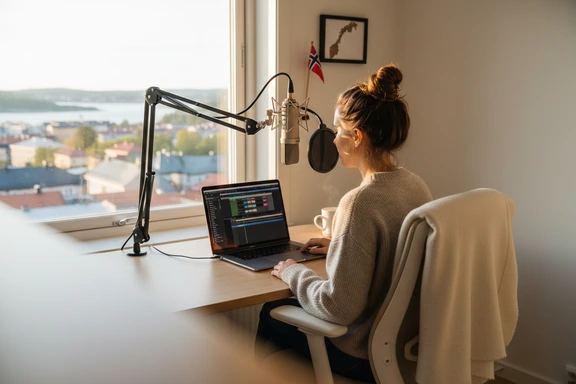
Add a native Norwegian voiceover to YouTube videos, podcast intros, or social-media clips. Pick a warm conversational tone for vlogs or a confident newscast register for explainers — export as an audio file and drop it straight into Premiere, DaVinci, or CapCut.
Language Learning & Pronunciation Practice
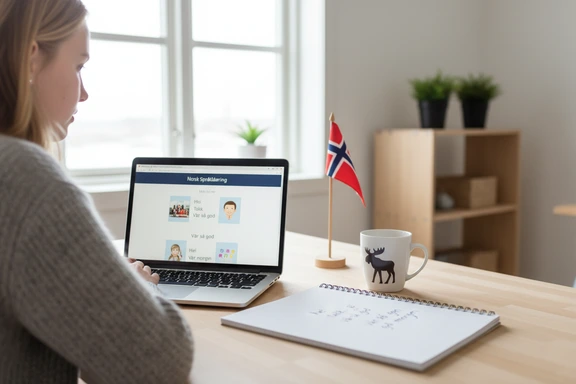
Hear how Tusen takk and Kjære venn actually sound before you try them in class. Paste vocabulary lists, dialogue exercises, or tricky tongue-twisters and slow the playback to 0.75× to isolate the pitch accent and kj-sound. Ideal for classroom drills and self-study alike.

Audiobooks & Narration
Turn a manuscript into an audiobook with a steady, natural narrator. Norway has a thriving audiobook culture — Storytel, Fabel, Nextory — and the HD tier delivers studio-level clarity that holds up alongside human-narrated titles. Use Dialog Mode to assign distinct voices to different characters.

Business Presentations
Voice a quarterly report, onboarding walkthrough, or investor deck in clearly articulated Bokmål. Ideal for internal training at Nordic companies where English slides need a Norwegian narration layer. Export the audio file and embed it directly in PowerPoint or Google Slides.
How to Generate Norwegian Voice in 3 Steps
Three steps from text to audio. No software, no signup.
Paste or type your Norwegian text
Type directly or paste up to 1,000,000 characters. Upload DOCX, PDF, or SRT files. Works with any Bokmål text — scripts, articles, study notes, dialogue.
Choose a Norwegian voice
Pick from 90+ native speakers — text to speech Norwegian covers both Neural and HD tiers. Adjust speed and pitch to match the tone you need, from a calm read-aloud to a natural voice for professional narration.
Listen & download free
Click Convert to Speech, preview the result, and download as MP3, WAV, or FLAC. First 1,000 characters free — no account needed. No watermark on any plan.
What Makes Norwegian Unique for TTS — Bokmål vs Nynorsk, Pitch & Dialects
Bokmål & Nynorsk
Norway has two official written standards. Bokmål — used by roughly 85 % of the population and dominant in media, schools, and government — is the standard these voices are trained on. Nynorsk is a parallel form based on rural dialects; all Norwegians understand both. If your text is in Bokmål, the result will sound natural right away.
Pitch Accent (Tonefall)
Norwegian uses tonal word accent — a melody pattern that can change meaning. The classic pair: bønner with a flat contour means “beans”, while the same word with a rising-falling contour means “farmers”. Neural voices trained on Oslo-standard speech reproduce these contours accurately, keeping your audio unambiguous.
Dialect Continuum
Spoken Norwegian varies significantly from Bergen to Tromsø, with each region carrying its own melody and vocabulary. The voices use standard East Norwegian (Oslo-area) pronunciation — the register heard on NRK broadcasts and understood everywhere in the country. This makes it the safest choice for content targeting a national audience.
Norwegian Text to Speech — FAQ
Yes. Paste any Norwegian text and convert it to speech for free — the first 1,000 characters require no account and no credit card. Create a free account to receive an extra 3,000 characters per day for seven days. Commercial use is permitted on every plan, including the free tier.
The voices are trained on Bokmål, which is the dominant written standard in Norway. If you paste Nynorsk text, the engine will read it aloud but may apply Bokmål intonation rules. For the most accurate result, use Bokmål source text or manually adjust spelling where the two standards differ significantly.
The voices are designed for native Norwegian text. If you paste English text into a Norwegian speaker, the result often carries a recognisable Nordic intonation — useful for character work or Scandinavian-flavoured narration. For a dedicated English accent, check the British or American accent pages instead.
Yes. Every plan — including the free tier — includes a commercial licence. You may use the generated audio in audiobooks, podcasts, YouTube videos, e-learning courses, presentations, and any other commercial or personal project. No watermark is added.
Norwegian and Danish are closely related — written Bokmål and Danish look almost identical — but they sound very different aloud. Norwegian has pitch accent and pronounces most consonants clearly, while Danish swallows consonants and uses the glottal stød. Use nb-NO voices for Norwegian and da-DK voices for Danish to get accurate results for each language.