Hong Kong Cantonese TTS — HD AI Voice
4 Hong Kong Cantonese AI voices — HD Achird + three neural, 廣東話.
4 HK Neural Voices — Traditional 廣東話, Nine Tones & HD Audio
This Hong Kong Cantonese text to speech page turns any Traditional script (廣東話, 繁體字) into an authentic HK reading — the register heard from Central to Kowloon, Sha Tin and Tuen Mun. Four native speakers — HiuMaan (female), WanLung (male), HD-tier Achird HK (male) and HiuGaai (female) — read with the tone contours, final particles and frequent English code-switching that define speech in 香港. Paste, pick a speaker, download a free MP3 — no signup.
Creators reach for this variety when a Mandarin reading feels wrong to a local ear. Feed the engine a line in 粵語 — "你好,歡迎嚟到我哋嘅頻道" or "一齊去飲茶啦" — and the speaker stays in the HK pocket, with the Middle Chinese checked stops (-p, -t, -k) that Putonghua has lost. For Mandarin use our Chinese Text to Speech; for the mainland Simplified variant heard in Guangzhou see our Cantonese (Simplified) TTS.
- 4 HK speakers — 3 Neural + 1 HD (Chirp3-HD Achird).
- HK register — Central, Kowloon & New Territories cadence.
- Traditional Chinese input 繁體字 (廣東話).
- 9-tone system preserved — 6 contour + 3 checked stops.
- Download MP3, WAV, FLAC, OGG.
- Free — 1,000 characters, no signup.
HK Cantonese AI Voices — Male & Female Hong Kong Speakers
Click to preview · 4 native HK speakers · 3 Neural + 1 HD
Four HK native speakers. Achird HK is the only HD-tier voice in our HK catalogue — higher fidelity prosody for commercial voice over work, TVB-style narration and polished ads. For Mandarin Putonghua or the mainland Simplified reading, visit the Chinese Text to Speech or Cantonese (Simplified) TTS pages.
HK Register vs Mandarin Putonghua — Pronunciation Comparison
Same character or meaning, two readings. Hear how the HK variety reshapes the sound against a Mandarin baseline — including the 9-tone system (6 contour + 3 checked) that Putonghua has lost.
What Makes HK Speech Sound Unique
- Nine-tone system — six contour tones (high-level, mid-rising, mid-level, low-falling, low-rising, low-level) plus three short checked tones on -p, -t, -k endings. A native model is the only realistic way to render this tonal density without audible flatness.
- Middle Chinese inheritance — final stops (-p, -t, -k), the bilabial -m coda, velar ng- initials and a g-/k- distinction Putonghua merged. Read aloud, Traditional script still carries these 1,000-year-old contrasts.
- Colloquial characters 唔/咁/冇/咗/嘅 — written-out spoken forms that Mandarin lacks. The engine reads them naturally inside regular Traditional prose, so social-media copy and subtitles sound colloquial, not stiff.
- English code-switching — daily HK speech weaves English in ("ok呀", "sorry lor", "meeting時間"). The speakers handle embedded English tokens with the local pronunciation rather than importing a full Anglo accent.
- Final particles — 嘅/啦/咩/喎/啊 carry the emotional weight of a sentence. Without them a reading sounds bookish; with them it sounds like something a friend would say at a 茶餐廳 table.
HK Conventions — Dollar, Date Format & Number Style
Local formatting rules shift how the same numbers read aloud. Four HK conventions worth feeding the voice correctly:
Numbers
15,000 — Arabic digits with commas every three places. Traditional characters appear in formal contexts: 一萬五千 (yat1 maan6 ng5 cin1).
Currency
HK$ 128.50 — the HK dollar, written HK$ or 港幣. Read as "一百二十八蚊五毫" — 蚊 (man1) for dollar, 毫 (hou4) for ten-cent.
Dates
22/04/2026 — British-legacy DD/MM/YYYY. Formal writing uses 2026年4月22日 with year-month-day order and 年月日 markers.
Time
14:30 — 24-hour clock in transport and public signage. Spoken HK still prefers 下午兩點半 — "two-thirty in the afternoon" — over the numeric reading.
What Can You Do with an HK AI Voice?

HK Creators & Cantopop
Voice HK street-food vlogs, Cantopop reaction videos and Mong Kok comedy skits for YouTube and TikTok. HiuMaan and WanLung land the Kowloon cadence and colloquial characters 唔/咁/冇/咗 that a Mandarin narrator would smooth into bookishness.
HK Heritage Learners
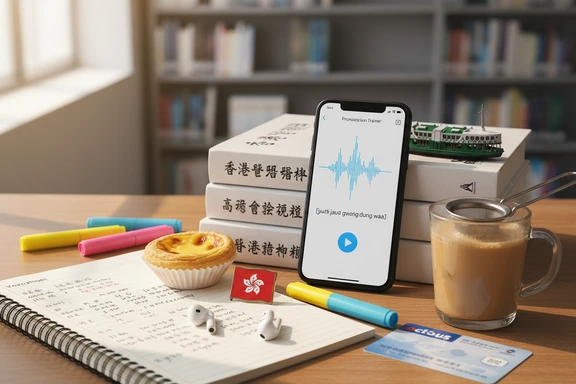
Drill Jyutping, tone contours and colloquial particles for second-generation HK diaspora families in Vancouver, Toronto, London and Sydney. Slow the speed, feed Traditional prose with 嘅/啦/咩, and practice the phonemes elders actually use at home.
HK SMEs & Diaspora Business
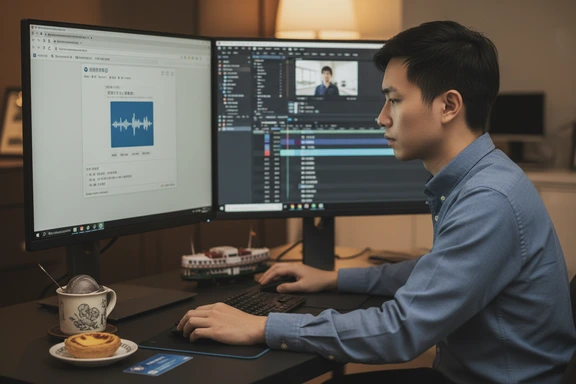
Dim sum restaurants, HK-style property firms, travel agencies and MTR-adjacent service brands in HK and the diaspora. Use HD Achird for polished IVR greetings, waiting-room messaging and brand ads that target Hongkonger customers directly.
TVB-style Voice Over
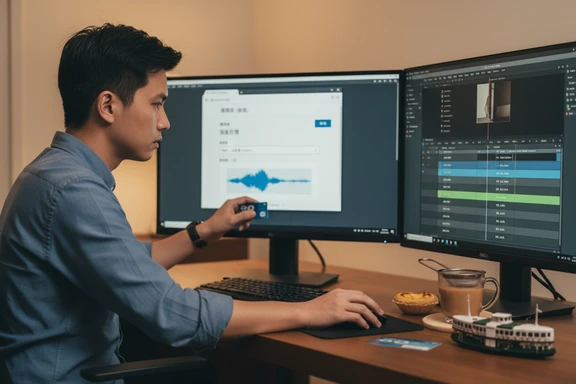
HK film dubbing, TVB-style narration, documentary voice over and audiobook production. Achird's HD prosody carries the polish commercial studios expect, while HiuMaan and WanLung handle longer-form reads at a fraction of studio cost.
HK Cantonese TTS — How It Works
Three steps to generate an HK reading online. No software, no signup.
Paste or type Traditional 繁體字
Up to 1,000,000 characters. Mix colloquial 廣東話 with English tokens — "我哋meeting喺三點" — the speaker handles both naturally.
Choose a voice
Pick HiuMaan, WanLung, HiuGaai, or the premium HD-tier Achird HK. Adjust speed and pitch.
Listen & download free
Convert, preview, export MP3, WAV or FLAC. First 1,000 characters free.
Frequently Asked Questions — HK Cantonese TTS
This page reads text written in Traditional characters 繁體字 (廣東話) — the HK standard used across newspapers, TVB subtitles, and everyday signage from Central to Sha Tin. The voices (HiuMaan, WanLung, HiuGaai, HD Achird) are trained on HK-register speech. For the mainland Simplified variant used in Guangzhou and Guangdong province, switch to our Cantonese (Simplified) TTS. Both share the same Yue Chinese spoken family, but differ in script, regional vocabulary (茶餐廳 in HK vs 饮茶 on the mainland), and voice register.
Hong Kong SAR — HK Island, Kowloon, New Territories — plus HK-origin diaspora communities in Vancouver, Toronto, San Francisco, Sydney, London, and the Chinatowns of New York and Boston. The HK register differs subtly from Guangzhou speech in vocabulary, English code-switching frequency and tone realisation.
It is the BCP-47 locale code for Hong Kong Cantonese: yue is ISO 639-3 for Yue Chinese, HK narrows the variety to the HK region. The full BCP-47 tag yue-Hant-HK adds the Hant subtag to specify Traditional Hanzi script — the form used throughout this page.
The engine reads Traditional Chinese characters natively (廣東話 text). Jyutping appears on this page as a pronunciation reference for learners — think of it as the equivalent of pinyin for Mandarin. For direct TTS input, paste Traditional Hanzi and hear the HK reading; Jyutping alone is not a supported input.
Yes — free MP3 download, no signup, no watermark. Commercial use is allowed: YouTube monetisation, Cantopop reaction videos, HK business ads, TVB-style documentary narration, IVR and restaurant audio tours. Your first 1,000 characters are free every day; larger projects are pay-as-you-go.
Achird HK is the only HD-tier speaker in our HK catalogue — higher fidelity prosody, smoother intonation, and more realistic pacing than the Neural tier. Use it for commercial work where a studio-polish reading matters. HiuMaan, WanLung and HiuGaai cover day-to-day narration at a lower per-character cost. The HD option is absent on the mainland Simplified sister page.
Pick HiuMaan, WanLung, HiuGaai or HD Achird and export the reading in seconds. Need Mandarin Putonghua instead? Visit the Chinese Text to Speech page.