Arabic Text to Speech
90+ voices across MSA and 8 regional dialects — free MP3 download.
90+ AI Voices — MSA, Egyptian, Maghrebi & Gulf Dialects
Arabic connects 420 million speakers across 22 countries, and each dialect sounds distinctly different. The library covers 91 voices total: 38 trained on MSA for news, education, and formal contexts, plus 55 Egyptian voices — the largest dialect collection available — and dedicated speakers for Moroccan Darija, Saudi, Iraqi, Lebanese, Syrian, Emirati, and nine more country variants. Pick a voice, adjust speed and pitch, download your file in seconds.
Right-to-left text is handled natively: paste Arabic script with or without tashkeel (diacritics), and the engine resolves harakat, shadda, and sun-letter assimilation automatically. Useful for YouTube voiceover in Egyptian colloquial, Quran study recordings in classical Fusha, corporate presentations for Gulf markets, language-learning drills, or any project that needs a reliable Arabic reader online. First 1,000 characters free, no account required.
- 91 voices — Standard, PRO, HD tiers
- MSA + 17 regional dialects covered
- RTL input with tashkeel support
- Download MP3, WAV, FLAC, OGG
- Free — 1,000 chars, no signup
Arabic Voice Samples — Standard & Dialect Speakers
Click to preview · 91 voices total
These are 4 featured MSA speakers. Browse all 91 on the voices page — filter by Arabic to find Egyptian, Moroccan, Saudi, Iraqi, and Levantine dialect voices.
Arabic Pronunciation — Phonetic Highlights
Sounds that make this language distinctive. Click play to hear how the engine handles each one.
What Makes These Sounds Challenging
- Guttural consonants — ع (ain), ح (ha), خ (kha), and غ (ghain) are produced deep in the throat. Most non-Semitic languages lack equivalents, so learners need repeated listening to distinguish them.
- Emphatic consonants — ص ض ط ظ are articulated with the tongue pressing against the palate, darkening the surrounding vowels. The contrast between ص and س (emphatic vs plain s) changes word meaning entirely.
- Hamza and sukun — the glottal stop (ء) and the zero-vowel marker (sukun) control rhythm and syllable boundaries. Correct placement prevents the flat, robotic delivery that plagues lower-quality engines.
Reading Arabic Text Aloud — Formatting Tips
How you format the source text affects the spoken output. Four conventions worth knowing:
Numbers
٣٥٠ → "thalathu-mi'a wa khamsoon" — the engine reads Eastern Arabic numerals (٠١٢٣) and Western (0123) equally well. Large numbers follow the standard hundreds-then-tens word order.
Diacritics (Tashkeel)
كتب → كَتَبَ — adding fatha, kasra, damma, and sukun removes ambiguity. Without diacritics the engine infers the most common pronunciation, but adding harakat ensures precision for Quranic or educational recordings.
Dates & Currency
١٥/٤/٢٠٢٦ — dates read day-first (the fifteenth of April). Currency symbols like ﷼ or د.إ are read in full: "riyal" or "dirham" respectively.
Punctuation & Pauses
Arabic comma (،) and question mark (؟) — the engine recognises right-to-left punctuation marks and inserts natural pauses. Use them instead of Latin equivalents for more accurate intonation.
Use Cases: Spoken Arabic in Action
Content Creation & Voiceover
Add narration to YouTube videos, podcasts, and social-media clips. Choose a formal MSA speaker for documentary-style projects or an Egyptian voice for conversational vlogs aimed at the largest dialect audience in the region. Export the file and drop it into Premiere, DaVinci, or CapCut.
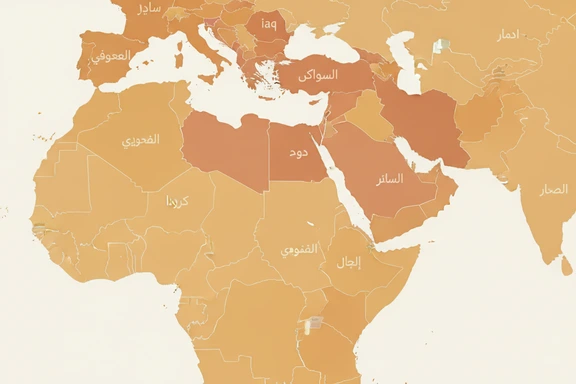
Regional Dialects Showcase
Compare how a sentence sounds in Egyptian, Moroccan Darija, Levantine, Gulf, and formal MSA — all from the same editor. Linguists, content localizers, and app developers use this to test how their product sounds in each market before committing to a single variant.
Language Learning & Drills
Hear vocabulary lists and short dialogues spoken by a native-level speaker. Slow playback to 0.75x to catch guttural consonants and emphatic pairs, then speed back up once you follow comfortably. Useful for university courses, self-study, and heritage speakers refreshing reading skills.
Business & Corporate Presentations
Voice slide decks and e-learning modules for Gulf and North African markets. An MSA speaker delivers formal quarterly reviews; a Saudi or Emirati voice localizes internal training for regional offices. Arabic audio makes presentations accessible and saves hours of manual recording.
How It Works
Three steps to turn written text into spoken Arabic. No software, no signup.
Paste or type your text
Type directly or paste up to 1,000,000 characters. Upload DOCX, PDF, or SRT files. Right-to-left script and diacritics (tashkeel) are supported natively.
Choose a voice or dialect
Pick from 91 speakers — MSA, Egyptian, Moroccan, Saudi, Iraqi, and more. Filter by gender and quality tier (Standard, PRO, HD). Adjust speed and pitch to match your project.
Listen & download free
Click Convert to Speech, preview the result, and download as MP3, WAV, or FLAC. First 1,000 characters free — no account needed. No watermark on any plan.
Language Spotlight — Dialects & Script
Dialect Coverage
Most platforms limit their voiceover catalog to Modern Standard Arabic. SpeechGen covers MSA and 17 country-specific dialects — 91 speakers in total. The breakdown:
| Dialect Group | Countries | Voices |
|---|---|---|
| MSA (Fusha) | All Arab countries (news, education, literature) | 38 |
| Egyptian | Egypt (~110M speakers) | 55 |
| Maghrebi | Morocco (Darija), Algeria, Tunisia, Libya | 8 |
| Levantine | Lebanon, Syria, Jordan, Palestine | 8 |
| Gulf | Saudi Arabia, UAE, Kuwait, Qatar, Bahrain, Oman | 14 |
| Iraqi | Iraq (~40M speakers) | 2 |
| Yemeni / Sudanese | Yemen, Sudan | 4 |
RTL & Diacritics
The editor accepts right-to-left input without switching modes. Tashkeel marks — fatha ( َ), kasra ( ِ), damma ( ُ), sukun ( ْ), and shadda ( ّ) — are parsed individually and shape vowel placement, stress, and consonant length. Text without diacritics is read in the default MSA pronunciation; adding harakat overrides it for precise Quranic or literary readings.
Sun & Moon Letters
Fourteen consonants (sun letters) absorb the l in the definite article al-: الشمس becomes ash-shams, not al-shams. The remaining fourteen (moon letters) keep it: القمر = al-qamar. The engine applies this assimilation rule automatically, matching how native speakers naturally pronounce the definite article.
Frequently Asked Questions
Yes. Beyond Modern Standard Arabic, the catalog includes 55 Egyptian voices, plus dedicated speakers for Moroccan Darija, Saudi, Iraqi, Lebanese, Syrian, Emirati, Algerian, Tunisian, Libyan, Jordanian, Kuwaiti, Qatari, Bahraini, Omani, Yemeni, and Sudanese variants. Select a dialect from the voice dropdown — no extra setup needed.
The first 1,000 characters are free with no account, no card, and no watermark. Create a free account for an additional 3,000 characters per day for seven days. Every tier — including free — allows commercial use. Download as MP3, WAV, FLAC, or OGG.
MSA (Modern Standard Arabic, also called Fusha) is the formal register used in news, books, and education across all Arab countries. Dialect voices reflect the everyday spoken language of a specific region — Egyptian sounds different from Moroccan Darija, and both differ from Gulf. Choose MSA for formal content and a dialect for conversational or region-specific projects.
Yes. The REST endpoint accepts plain text or text with tashkeel, returns the generated file, and supports all 91 voices. Documentation, code samples, and a sandbox are available in the developer section. Free tier includes limited monthly requests; paid plans scale up.
No. Everything runs in the browser — paste text, pick a voice, click Convert to Speech. Works on desktop and mobile, any operating system. No plugins, no downloads, no account required for the free tier.