Yemeni Arabic TTS — Sana'ani & Adeni Voice
2 Yemeni Arabic AI voices — Sana'ani & Adeni accent. Free MP3, no signup.
Yemeni Arabic — Sana'ani Highland & Adeni Coastal Dialects
This Yemeni Arabic text to speech page turns any script into an authentic Sana'ani reading — the highland register heard from the Old City of Sana'a down to Taiz and Hodeidah, and out along the Red Sea to the port of Mocha that first gave coffee its name. Two native ar-YE neural speakers, Maryam (female) and Saleh (male), carry the melodic cadence linguists often call the modern Arabic closest to the classical source. Paste, pick a speaker, download a free MP3 — no signup.
The highland register keeps the /g/ of ج (as in "gamal" for camel), retains the final case endings other dialects drop, and carries vocabulary from the Sabaean and Himyaritic kingdoms that once hosted the Queen of Sheba on the Arabian Peninsula. For MSA or other regional Arabic variants, see our main Arabic page.
- 2 native ar-YE speakers — Neural tier
- Sana'ani & Adeni register — classical Arabic retention
- Hadhrami diaspora reach — UK, US, Horn of Africa
- Download MP3, WAV, FLAC, OGG
- Free — 1,000 characters, no signup
Yemeni Voices — Maryam & Saleh from Sana'a
Click to preview · 2 native ar-YE speakers total
Both native speakers read a central Sana'ani register that Adeni and Hadhrami listeners follow easily. For الفصحى, Egyptian, Gulf, Levantine or Maghrebi variants visit the main Arabic page.
Sana'ani vs MSA (الفصحى) — Pronunciation Comparison
Same word, two readings. Hear how the highland register reshapes Arabic against the MSA baseline.
What Makes Yemeni Arabic Sound Unique
- Classical Arabic retention — the highland register preserves the /g/ of ج, retains final short vowels (i'rab case endings) and keeps archaic plurals. Linguists rank this speech as the modern variety closest to the pre-Islamic Arabic of the peninsula.
- Sabaean & Himyaritic substrate — vocabulary survives from the pre-Islamic South Arabian kingdoms that ruled the frankincense and myrrh routes and hosted the Queen of Sheba. Mountain villages still use roots absent from the rest of the Arabophone world.
- Melodic Sana'ani intonation — a distinctive rising-falling pitch contour colours highland speech; a listener from Cairo or Beirut picks it up in one sentence.
- Three sub-dialects — Sana'ani (highland, classical-leaning), Adeni (coastal, centuries of southern port contact), and Hadhrami (eastern valleys and an Indian-Ocean diaspora reaching Sheffield, Singapore and Indonesia).
Local Conventions — Rial, Date Format & Number Style
Formatting rules shift how the same numbers read aloud. Four ar-YE conventions worth feeding the voice correctly:
Numbers
1,234 — both Latin digits and Arabic-Indic numerals (١٢٣٤) are used. Indic numerals are more common in formal and religious contexts.
Currency
10,000 ﷼ — the rial (YER). Written "ر.ي" or YER. Historically the Maria Theresa thaler was also used in Red Sea and Horn-of-Africa trade.
Dates
24/04/2026 — day-first DD/MM/YYYY is standard. The Hijri calendar is frequently written in parallel: "24 Shawwal 1447 AH".
Time
14:30 — 24-hour for broadcast and official copy; 12-hour with صباحاً / مساءً for daily speech. Prayer-call times (أذان) are cultural anchors.
What Can You Do with a Yemeni AI Voice?
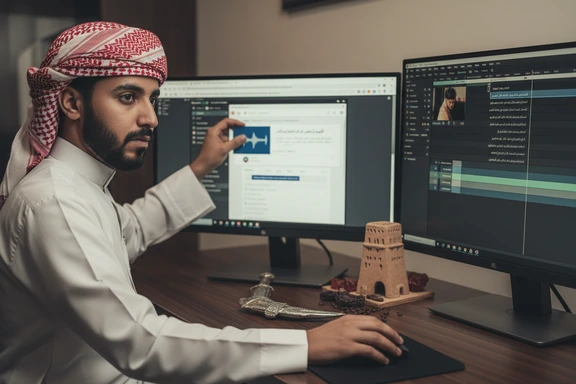
Heritage & Travel Narration
Narrate the UNESCO-listed Old City of Sana'a, the port of Mocha that gave coffee its name, Shibam's mud-brick tower houses, and the dragon-blood trees of Socotra. Maryam and Saleh carry the classical cadence of the highland register — ready for documentary voice-over, museum audio guides, and heritage channels on YouTube.

Diaspora Content
Hadhrami communities settled across the Indian Ocean rim — Sheffield and Cardiff in the UK (since the 1860s), Detroit and New York, Djibouti and Somaliland, Singapore and Indonesia. Diaspora creators on TikTok, Reels and YouTube reach these audiences in the parent tongue with an authentic highland accent.

Tribal Qasida & Poetry
The highland cadence still carries the tribal qasida tradition from al-Hamdani onward. Generate audio for poetry recitations, literature podcasts and language channels — the melodic rise-fall and the /g/ of ج restore the rhythm poets wrote for a thousand years ago.
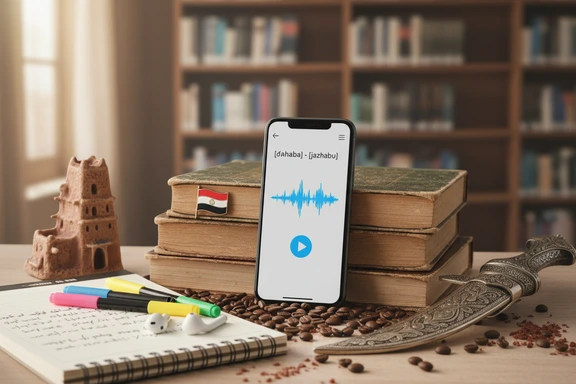
Classical Arabic Learning
Because the highland register retains i'rab (case endings) and the /g/ of ج, it acts as a bridging voice between colloquial ear-training and الفصحى. Learners and researchers feed study cards into the editor and export ar-YE MP3 for contrastive pronunciation drills.
Yemeni Arabic TTS — How It Works
Three steps to generate an ar-YE reading online. No software, no signup.
Paste or type your text
Up to 1,000,000 characters. Paste Arabic script, Latin transliteration, or a mix — the speaker handles both.
Choose a voice
Pick Maryam (female) or Saleh (male). Adjust speed and pitch.
Listen & download free
Convert, preview, export MP3, WAV or FLAC. First 1,000 characters free.
Frequently Asked Questions — Yemeni Arabic TTS
The Sana'ani register is widely considered the modern Arabic closest to the classical source. The letter ج often sounds as /g/ (as in "gamal" for camel), conservative speech preserves final short vowels (i'rab case endings), and Sabaean and Himyaritic vocabulary survives in mountain villages. Highland speech also carries a distinctive melodic rise-fall unique to the Arabian Peninsula's south-Arabian variant.
Sana'ani is the highland dialect of the capital — conservative, melodic, classical-leaning. Adeni is the coastal register of Aden, shaped by centuries as a southern port (British protectorate until 1967) and carrying a measurable Gulf influence. A third variety, Hadhrami Arabic, is spoken in the eastern Hadhramaut valleys and across a large diaspora on the Indian Ocean rim. The two ar-YE voices use a central Sana'ani-based register that listeners in all three zones follow easily.
No. The speech of the Arabian south is a distinct branch, historically shaped by the Sabaean and Himyaritic civilisations and by the highlands themselves (اللهجة اليمنية). Gulf Arabic (Saudi Arabia, UAE, Qatar, Kuwait, Bahrain) descends from the Najdi Bedouin tradition. Adeni shows some Gulf contact, but Sana'ani and Hadhrami are clearly separate.
Two Neural speakers — Maryam (female) and Saleh (male). Both read a central Sana'ani register intelligible for Adeni and Hadhrami listeners. Paste your text, pick a speaker, export MP3.
Yes. The classical-leaning highland cadence fits tribal qasida narration, Old City of Sana'a (UNESCO) heritage tours, Mocha coffee-origin stories, and content aimed at communities in the UK, US and the Horn of Africa. Free MP3 download, no signup.
Pick Maryam or Saleh and export the reading in seconds. Need another Arabic variant? Visit the main Arabic page.