Chinese & Hong Kong English Accent Generator
2 native Hong Kong English voices — Cantonese-influenced accent, free MP3.
2 Neural Voices — Cantonese-Inflected English, Non-Rhotic R & Clipped Finals
Listen to any English text read aloud in a genuine Hong Kong accent — Sam and Yan are en-HK Neural speakers trained on the Cantonese-inflected pronunciation of real Hong Kong broadcasters, not a parody. What most listeners call a "chinese accent in english" is in fact Hong Kong English, a recognised World English variety where Cantonese phonology shapes every vowel and consonant. This page is for that accent — if you need Mandarin or Cantonese speech, those are separate tools on the site.
Creators reach for these voices when a project calls for an authentic asian accent speaker: narrating a travel documentary set around Victoria Harbour, voicing a cosmopolitan character in an indie game, recording an audiobook rooted in Hong Kong fiction, or building listening drills for students studying World Englishes. The en-HK catalogue delivers the clipped finals, the flat intonation curve and the characteristic TH-fronting that mark Hong Kong English — all in a natural, respectful register ready for commercial voiceover. Adjust speed from 0.5x to 2.0x, tune pitch, and download your audio free as an mp3 file.
- 2 real en-HK Neural speakers (Sam & Yan)
- Cantonese-influenced prosody & TH substitution
- Adjustable speed 0.5x–2.0x & pitch
- Download MP3, WAV, OGG, FLAC
- Free — 1,000 chars, no signup
Hong Kong English Speaker — Voice Samples
Click to preview · 2 Hong Kong voices total
These are the 2 native en-HK voices in the catalogue. Filter by en-HK in the voice selector above.
Hong Kong English Pronunciation — What's Different
The same word sounds noticeably different in Hong Kong English and General American. Click play to compare side by side — you will hear the Cantonese-derived patterns that give this accent its texture.
What Makes Hong Kong English Sound Unique
- TH-fronting — Cantonese has no dental fricative /θ/, so speakers replace it with /f/ or /t/. "Thanks" becomes /fæŋks/, "three" becomes /fri/. This is the single most recognisable marker of the accent.
- Non-rhotic R — like British English, the R after vowels is dropped or softened. "World" loses its final consonant cluster entirely, coming out closer to /wɜː/.
- Final consonant simplification — Cantonese syllable structure rarely allows clusters at the end, so combinations like "ld", "st" and "ct" get trimmed. "School" loses the final L; "next" may lose the "t".
- Cantonese-derived prosody — the intonation curve is flatter and more even than in American English, with shorter pitch contours shaped by Cantonese tonal habits.
Hong Kong English Conventions
Formatting details that change how the text to speech reader handles your input. Four conventions worth knowing for Hong Kong:
Numbers
"one point five million" — Hong Kong uses the million/billion scale (no lakh, no crore). Prices often carry the HK$ prefix: HK$120 reads as "one hundred and twenty Hong Kong dollars".
Currency
HK$88 — "eighty-eight Hong Kong dollars". Smaller sums: $5.50 reads naturally. In formal text the currency code HKD appears, but for spoken output stick with the dollar symbol and let the voice handle it.
Dates & Time
7 April 2026 — day-first format, the same as British convention. Government documents sometimes use YYYY-MM-DD. The 24-hour clock is common in transport schedules: 14:30 reads "fourteen thirty".
Spelling
colour, centre, realise — Hong Kong follows British spelling. Local vocabulary adds "lift" instead of "elevator", "flat" instead of "apartment", and "MTR" for the metro system.
Where Creators Use Hong Kong English Voices

Content Creation & Voiceover
Add a Hong Kong English narrator to travel vlogs, product reviews aimed at the Asian market, or food-walk videos around Central and Sheung Wan. A local accent gives the audio an on-the-ground feel that a generic American reading cannot match. Export the file and drop it straight into Premiere, DaVinci, or CapCut.
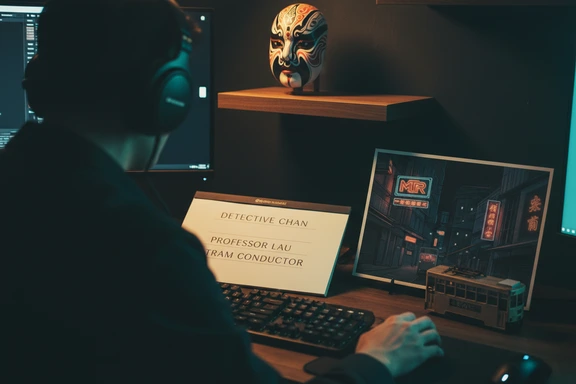
Character Voices & Storytelling
Cast a Hong Kong detective, a university professor, or a Kowloon street-vendor in your indie game, animation, or audio drama. The natural accent reads as authentic rather than stereotypical — adjust pitch and speed to shape each role. Works for pre-vis scratch tracks and final production alike.

ESL Listening & World Englishes
Train your ear on a real asian english accent. Slow playback to 0.75x to catch the final-stop consonants and the flat intonation, then speed it up once you follow along. Useful for linguistics students mapping phonological transfer from Cantonese and for teachers building listening drills that go beyond standard American audio.

Asian Fiction & Narration
Give English-language novels set in Hong Kong the narrator they deserve. A local voice reads Xu Xi, Dung Kai-cheung, or Qiu Xiaolong with the right intonation — no need to force a General American reader onto a story that unfolds around Tsim Sha Tsui and the Star Ferry. Export chapter-length audio and assemble a full audiobook.
How the Chinese Accent Generator Works — 3 Steps
Three steps to convert English text to speech with a Hong Kong accent online. No software, no signup.
Paste or type your text
Type directly or paste up to 1,000,000 characters. Upload DOCX, PDF, or SRT files. Any English text works — scripts, dialogue, study notes, full chapters.
Pick Sam or Yan
Choose between Sam (male) and Yan (female) — both are Neural voices trained on real Hong Kong English. Filter by en-HK in the voice selector, then adjust speed and pitch to match your project.
Listen and download free
Click Convert to Speech, preview the result, and download as an audio file in several formats. First 1,000 characters free — no account needed. No watermark on any plan.
Frequently Asked Questions
For most practical purposes, yes — what Western listeners call a "chinese accent" in English is usually the Cantonese-influenced pronunciation typical of Hong Kong. It is a recognised variety of World English with its own phonological rules: TH-fronting, non-rhotic R, clipped final consonants, and a flatter intonation pattern shaped by Cantonese tone habits. The voices on this page reproduce exactly that sound, because they are trained on real en-HK speakers.
Three entirely different products. Hong Kong English (this page) reads English text with a Hong Kong accent — useful for voiceover, narration, and listening practice. Cantonese tts reads Cantonese text in Cantonese (yue-HK). Mandarin reads Chinese text in standard Mandarin (cmn-CN). If you paste English here, you get english to chinese accent audio. If you need Chinese-language speech, visit the Cantonese or Mandarin pages instead.
Cantonese is the first language for most Hong Kong residents, and its phonology transfers into English: Cantonese has no /θ/ sound, so "thanks" becomes /fæŋks/; syllables rarely end in consonant clusters, so "world" shortens to /wɜː/; and the L/R distinction blurs because Cantonese treats those sounds differently. The result is a natural accent, not a mistake — Hong Kong English has been studied and documented by linguists for decades as a legitimate variety of English.
Yes. Commercial use is included in every plan, including the free tier. Download your audio as an mp3 or another format, and use it in YouTube videos, podcasts, e-learning modules, indie games, or any other project. No watermark is added to the output on any plan.
Sam and Yan deliver a natural Hong Kong English accent — authentic but not exaggerated. For character work in games and animation, that natural register sounds more respectful and believable than a caricature. Lower the speed to 0.85x for a more deliberate, pronounced feel, or raise pitch slightly for a lighter tone. The chinese accent ai voice adapts well to a range of character types, from a university lecturer to a street-market vendor in Kowloon.