English IPA Chart — Hear Every Sound, Convert IPA to Speech
09-09-2025 , 19-06-2026
Complete English IPA chart with audio on every symbol — consonants, affricates, diphthongs, long and short vowels, the schwa, and stress marks. The groups below mirror the phoneme keyboard built into the SpeechGen editor. Drop any transcription into the SSML <phoneme> tag and force exact pronunciation.
<phoneme alphabet="ipa" ph="…">…</phoneme> and the engine pronounces it exactly as transcribed. The chart and tables below are voiced by native English voices Den and Andrew; the phoneme-tag demos use Joey, an Amazon-engine voice that applies IPA transcriptions.
English Consonants in IPA
English has 24 consonant phonemes. Most map onto familiar letters, but a few symbols differ from spelling: [θ] and [ð] for the two th sounds, [ʃ] for sh, [ʒ] for the s in leisure, [ŋ] for ng, and [j] for the y sound. See the dedicated TH and R sections below.
| IPA | Example | Transcription | Listen |
|---|---|---|---|
| b | bubble | [ˈbʌbəl] | |
| d | dog | [dɔːɡ] | |
| f | frog | [frɒɡ] | |
| ɡ | gravely | [ˈɡreɪvli] | |
| h | mahogany | [məˈhɒɡəni] | |
| j | younger | [ˈjʌŋɡər] | |
| k | crown | [kraʊn] | |
| l | lately | [ˈleɪtli] | |
| m | mapping | [ˈmæpɪŋ] | |
| n | nine | [naɪn] | |
| ŋ | bank | [bæŋk] | |
| p | popular | [ˈpɒpjələr] | |
| ɹ | roaring | [ˈrɔːrɪŋ] | |
| s | massage | [məˈsɑːʒ] | |
| ʃ | shopping | [ˈʃɒpɪŋ] | |
| t | tinker | [ˈtɪŋkər] | |
| v | valve | [vælv] | |
| w | whirlwind | [ˈwɜːrlwɪnd] | |
| z | zoom | [zuːm] | |
| ʒ | leisure | [ˈleʒər] |
English Affricates ([tʃ] and [dʒ])
Affricates are single phonemes that begin as a stop and release as a fricative. English has two: the voiceless [tʃ] (the ch in changed) and the voiced [dʒ] (the g in magenta or j in jump). They appear as their own keys on the phoneme keyboard.
| IPA | Example | Transcription | Listen |
|---|---|---|---|
| tʃ | changed | [tʃeɪndʒd] | |
| dʒ | magenta | [məˈdʒɛntə] |
The TH Sounds in IPA ([θ] and [ð])
English spelling writes both th sounds the same way, but they are two distinct phonemes — and neither exists in many other languages, which is why learners and TTS engines often confuse them. The phoneme tag lets you pin down exactly which one you mean.
[θ] — voiceless (no vocal-cord buzz)
The breathy th in thigh, think, and bath. The tongue tip touches the teeth and air flows without voicing.
[ð] — voiced (vocal cords buzz)
The soft th in mother, this, and breathe. Same tongue position as [θ], but the vocal cords vibrate.
The English R Sound in IPA ([ɹ] and [ɚ])
English R is a retroflex or bunched approximant [ɹ] — the tongue never touches the roof of the mouth, unlike the trilled R of Spanish or the uvular R of French and German. In American English the R also colors neighboring vowels.
[ɹ] — the consonant R
At the start of syllables, as in roaring or crown.
[ɚ] — the R-colored vowel (American)
In unstressed -er endings the vowel and R fuse into a single rhotic sound, as in water or better. Stressed, it becomes [ɝ] as in bird.
English Vowels in IPA
English vowel sounds far outnumber the five vowel letters. The keyboard splits them into monophthongs (single, steady vowels), long vowels marked with [ː], diphthongs (gliding from one vowel to another), and the unstressed schwa pair. Note that exact vowels shift between American and British English.
| IPA | Type | Example | Transcription | Listen |
|---|---|---|---|---|
| ɪ | short | kit | [kɪt] | |
| iː | long | unique | [juˈniːk] | |
| ɛ | short | bed | [bɛd] | |
| æ | short | cat | [kæt] | |
| ɑː | long | cot | [kɑːt] | |
| ʌ | short | pulse | [pʌls] | |
| ɔː | long | more | [mɔːr] | |
| ʊ | short | could | [kʊd] | |
| uː | long | school | [skuːl] |
Type IPA symbols straight from the editor's keyboard (see below) — no need to memorize Unicode codes. The chart at the top of this page also copies any symbol to your clipboard on click.
English IPA Diphthongs
| IPA | As in | Example | Listen |
|---|---|---|---|
| aɪ | price, my, eye | price [praɪs] | |
| aʊ | flower, how, out | flower [ˈflaʊər] | |
| eɪ | shade, day, rain | shade [ʃeɪd] | |
| ɔɪ | choice, boy, coin | choice [tʃɔɪs] | |
| oʊ | boat, go, snow | boat [boʊt] |
A diphthong glides from one vowel position to another within a single syllable. American English typically counts five core diphthongs; British English adds centring diphthongs like [ɪə] (near) and [eə] (square) that American speakers render with an R instead.
The Schwa in English ([ə])
The schwa [ə] is the most common sound in spoken English — the lazy, neutral vowel that unstressed syllables collapse into. It is never spelled consistently: it hides in the a of again, the o of sofa, and both a's of banana. Mastering the schwa is what makes synthesized speech sound natural rather than robotic.
| IPA | Where it appears | Example | Listen |
|---|---|---|---|
| ə | unstressed first syllable | again [əˈɡɛn] | |
| ə | unstressed final syllable | sofa [ˈsoʊfə] | |
| ə | multiple reductions | banana [bəˈnænə] | |
| ɚ | R-colored schwa (US) | water [ˈwɔːtɚ] |
Stress & Syllable Marks
English stress is phonemic — it can change a word's meaning or part of speech. The primary stress mark ˈ precedes the stressed syllable, secondary stress uses ˌ, and a period . marks a syllable boundary. Compare the noun REcord with the verb reCORD.
<phoneme alphabet="ipa" ph="fəˈtɒɡrəfi">photography</phoneme>
<phoneme alphabet="ipa" ph="ˌʌndərˈstænd">understand</phoneme>
Move the stress to another syllable
Because the stress mark is just a character in the transcription, you decide which syllable carries it — useful for heteronyms whose meaning depends on stress. Put ˈ before the syllable you want emphasized and the engine follows. Listen to the same spelling stressed two different ways (voiced by Joey):
Same trick works for any word the engine stresses wrongly — move ˈ in front of the syllable you want, and add secondary stress with ˌ for longer words.
Using the <phoneme> Tag in Practice
When a word has more than one accepted pronunciation, the phoneme tag lets you pin down exactly which one you want. The classic example is GIF — listen to the same spelling forced two ways (voiced by Joey, an Amazon-engine voice that honors the IPA tag):
Typical candidates for the phoneme tag:
- Proper names — Saoirse [ˈsɜːrʃə], Hermione [hɜːrˈmaɪəni]
- Loanwords — quinoa [ˈkiːnwɑː], niche [niːʃ]
- Heteronyms — the noun record [ˈrɛkɚd] vs the verb [rɪˈkɔːrd]
- Technical terms — hyperbole [haɪˈpɜːrbəli], epitome [ɪˈpɪtəmi]
Compose IPA Visually — Built-in Keyboard
You don't need to memorize IPA symbols or hunt for them in a character map. SpeechGen has an interactive phoneme keyboard inside the editor, grouped exactly like the chart at the top of this page — consonants, affricates, diphthongs, long and short vowels, the unstressed pair, plus stress and syllable marks. Every key carries an English example word so you always know which sound you're picking.
-
Open speechgen.io and make sure an English voice is selected (Den, Andrew, Matthew — any
en-USvoice). -
In the editor toolbar click the
</> SSMLtoggle. The SSML tag bar appears. Click Phoneme.
-
The Phoneme (IPA) · en-US modal opens with the full English IPA keyboard. Click symbols to build the transcription in the input field, hit Listen to preview, then Insert to drop the
<phoneme alphabet="ipa">tag into your text. Tip: if you select a word first and leave the field empty, the editor tries to generate the IPA automatically.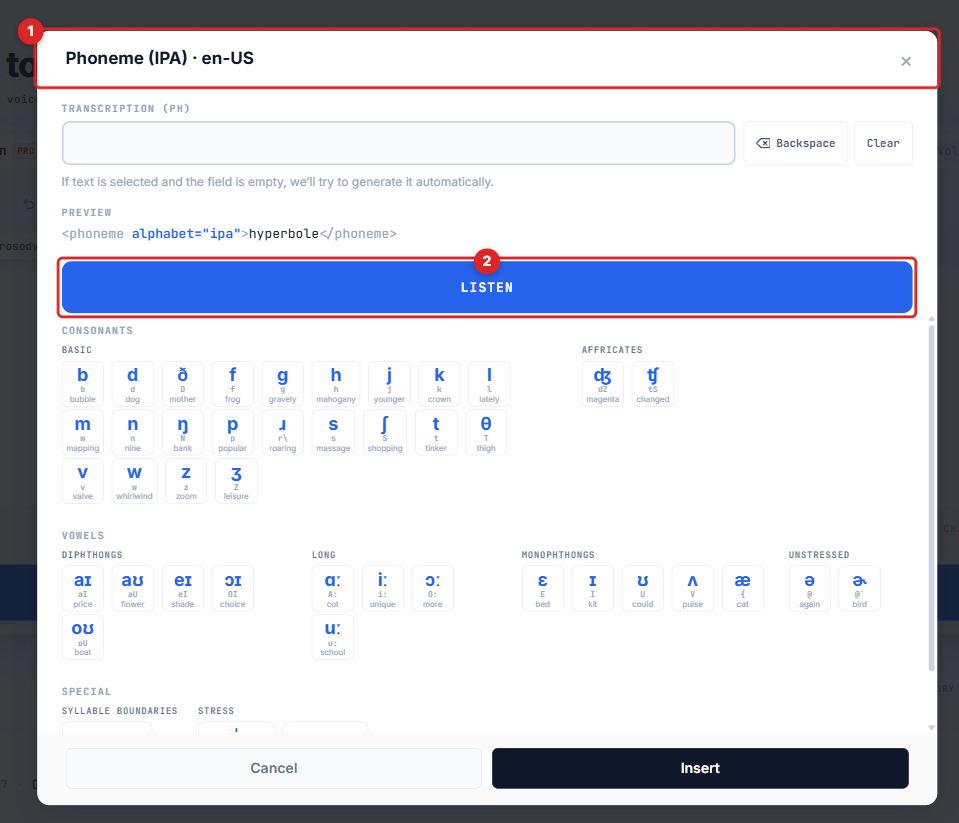


The keyboard adapts to the voice's language automatically — switch to a British, Indian, or Australian English voice and the example words and available symbols update to match that accent.
Frequently Asked Questions
What is the English IPA chart?
What are the two TH sounds in IPA?
How is the English R written in IPA?
What is the schwa and why does it matter?
How do I convert IPA to speech?
<phoneme alphabet="ipa" ph="[transcription]">Word</phoneme> in the SpeechGen editor, or build the transcription visually with the built-in IPA keyboard. For example <phoneme alphabet="ipa" ph="haɪˈpɜːrbəli">hyperbole</phoneme> forces the correct pronunciation. Use it for names, loanwords, heteronyms, and any term the engine gets wrong.